

Ether Fi Card
Borrow against your ETH or restaked ETH, spend the loan on a Visa card, and let the collateral keep earning yield.

Ether.fi Cash Card: Fees, Cashback, Borrow Mode And Vault Custody
What is Ether Fi Card?
Ether.fi Cash is a Visa debit and credit card that lets you spend or borrow against ETH and stablecoins from a self-custody vault, with up to 3 percent cashback and no annual fee.
Ready to try Ether Fi Card?
Open the official site and get started in a few clicks.
Ether Fi Card Overview
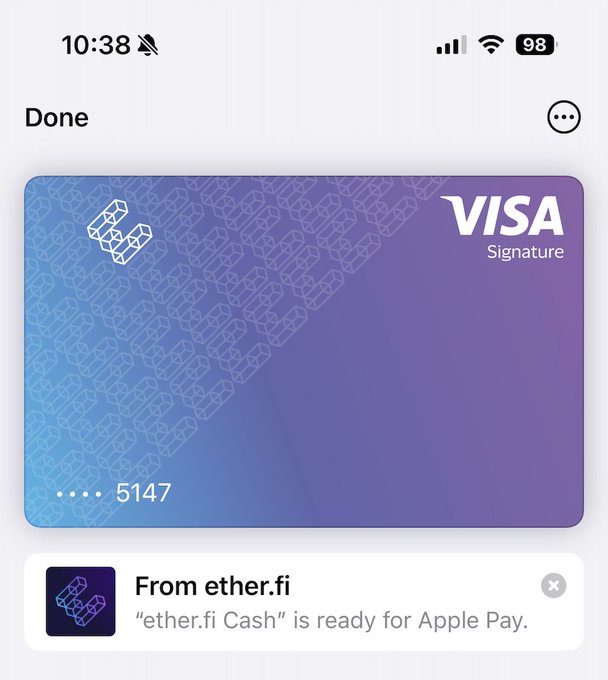
Ether.fi Cash is a Visa spending card tied to a vault you control on chain. It is not a prepaid exchange balance and not a bank checking account. You fund the vault with supported crypto, then either spend stablecoins directly or borrow against your collateral. The card works at Visa merchants and loads into Apple Pay and Google Pay.
The card fits people who already hold ETH, restaked ETH, or stablecoins and want to pay for rent, groceries, or subscriptions without selling any of it. It suits ETH holders who treat a sale as a tax problem and would rather borrow against weETH or wETH. It also suits stablecoin users chasing cashback higher than a typical bank card, and travelers spending in USD or EUR who want a lower FX margin. It does not suit anyone in a country the card blocks, anyone who wants bank-style deposit insurance, anyone who plans to rely on ATMs, or anyone who won't complete KYC.
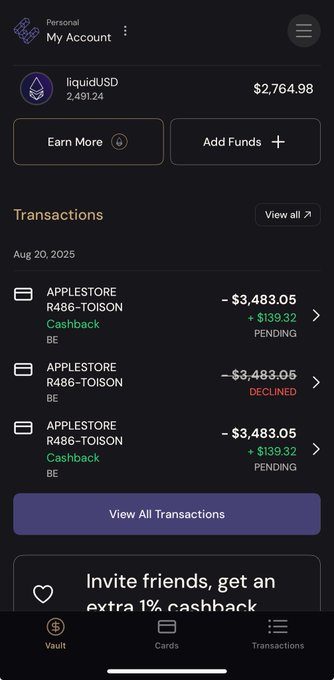
Two modes handle spending. Direct Pay spends USDC or LiquidUSD straight from your vault, no interest attached. If the stablecoin balance runs short, the payment fails, which keeps it closer to a debit card. Borrow Mode works the other way: you post supported assets as collateral, then spend borrowed USDC or EURC while the collateral itself can keep earning staking or vault yield. Interest starts the moment you borrow, and reviewers commonly cite a rate near 4% APY with no grace period. Loan-to-value differs by asset, with stablecoins sitting near 90%, wETH and weETH near 55%, and ETHFI lower still. If collateral value drops too far, spending can freeze and the position can face liquidation, so this side of the card is closer to DeFi credit than a bank credit line.
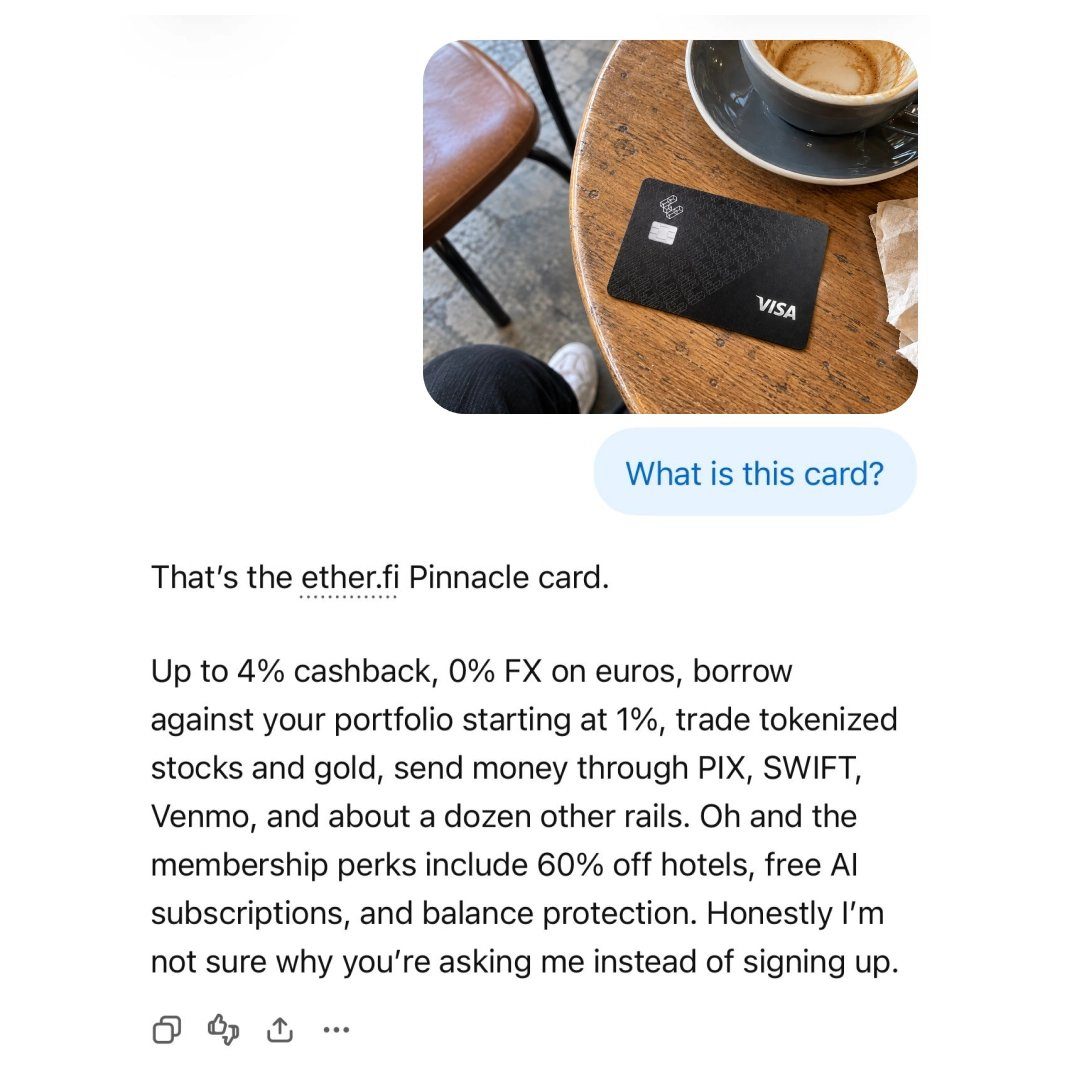
Cashback is tiered rather than flat. The headline rate reviewers cite is 3% on eligible spend for the free Core tier and the paid Luxe and Pinnacle tiers, stepping down once monthly spend crosses certain bands, with an invite-only VIP tier listed at 4% on the official site. Payout asset has changed across ether.fi's own help pages over time, so the in-app ledger is the only reliable source for what you'll actually receive that month. ATM withdrawals, P2P transfers, and some merchant categories often earn nothing.
What sets this card apart from a typical exchange card is the vault itself. Instead of a centralized float sitting on a platform's balance sheet, your funds sit in a smart contract vault, and the collateral behind Borrow Mode keeps earning yield while it backs your spending. That's the whole pitch: spend against assets that stay productive instead of cashing them out. The tradeoff is that you're trusting vault code and a lending market instead of a bank, and if you use Borrow Mode you need to watch your loan-to-value the way you'd watch a margin position, not the way you'd watch a credit card statement.
Settlement runs on Optimism after the card's move off Scroll in April 2026, with Ethereum, Base, Arbitrum, and HyperEVM listed as top-up chains in ether.fi's technical docs. Withdrawal routes are narrower than deposit routes, so it's worth checking the live deposit widget before sending anything, rather than trusting an older screenshot or guide.
Ether Fi Card Key features
-
Non-custodial Safe vault
Each user gets a smart contract vault instead of an exchange balance. Ether.fi says it cannot move your funds without your approval, though the vault code and cross-chain bridges still carry their own risk.
-
Direct Pay spending
You spend USDC or LiquidUSD straight from your vault like a debit card and pay no borrow interest. If your stablecoin balance runs short, the payment fails.
-
Borrow Mode credit line
Post ETH, weETH, wETH, or stablecoins as collateral and spend borrowed USDC or EURC while the collateral keeps earning yield. Reviewers commonly cite about 4 percent APY with no grace period, and loan-to-value runs near 90 percent on stablecoins but only around 55 percent on ETH assets.
-
Tiered stablecoin cashback
Core, Luxe, and Pinnacle pay 3 percent cashback on an initial spending band, then the rate steps down as your monthly spend rises. Invite-only VIP is listed at 4 percent, and the payout token has shifted between wETH, USDC, and SCR across different help pages, so check the in-app ledger for what applies now.
-
Virtual and physical cards
Virtual cards work right after KYC and funding, and physical cards opened for order in January 2026. Core members often pay a refundable deposit or fee near 40 to 50 dollars, while higher tiers get a free physical or metal card.
-
Apple Pay and Google Pay
You can tokenize the virtual card into either wallet and tap to pay in stores. Some users report fewer declines through the wallets than with typed-in card numbers on foreign purchases.
-
Multi-chain funding
The core vault sits on Optimism, with Ethereum, Base, Arbitrum, and HyperEVM listed as top-up chains, and some reviewer maps add Solana and Tron for certain assets. Withdrawal routes are narrower than deposit routes, so confirm the token and chain in the live deposit screen before you send anything.
-
Yield on idle collateral
Liquid vault deposits and cash balances can keep earning staking or restaking yield while you spend against them. The card does not create this yield itself, it lets you spend against assets that stay productive instead of selling them.
-
FX and ATM costs
USD spending carries no extra card-side fee, and EUR is marketed at 0 percent FX during a current beta, though other currencies add about 1 percent on top of Visa's own rate. ATM cash costs about 2 percent and is capped near 250 dollars per try, three tries a day, and it earns no cashback.
-
Licensed transmitter, not a bank
The card is issued through Third National, a Puerto Rico licensed money transmitter, not a US bank deposit account, so the vault carries no FDIC insurance. Marketing mentions balance protection up to 500,000 dollars per account, but ether.fi says that coverage is not live yet.
Ether Fi Card Fees
-
Annual fee No annual fee is charged on any named tier (Core, Luxe, Pinnacle).
-
FX spread USD spend adds 0 percent extra; EUR is marketed at 0 percent FX in beta; other currencies add about 1 percent on top of Visa's rate, with some Core testers measuring an all-in foreign cost near 1.7 percent, while higher tiers cut the ether.fi margin toward 0.
-
ATM withdrawals About 2 percent per withdrawal, capped around 250 USD per try and three tries per 24 hours (roughly 750 USD a day), and ATM cash does not earn cashback.
-
Fiat conversion and rails Fiat-to-crypto conversion inside the app runs about 0.2 percent on many tiers, with monthly fiat rail caps around 10,000 USD on Core, 50,000 USD on Luxe, and 200,000 USD on Pinnacle.
-
Card and borrow fees A physical Core card carries a deposit or fee in the 40 to 50 USD range, extra virtual cards run about 10 USD each after the free allotment, and Borrow Mode interest is variable, commonly cited near 4 percent APY with no grace period.
Ether Fi Card Supported networks
 Optimism
 Ethereum
 Base
Base Arbitrum
- HyperEVM
 Solana
 Tron
Tron- Scroll
How to use Ether Fi Card
-
Verify your identity
Open the ether.fi app or the Cash web flow and start an account with email or wallet connect. Confirm phone OTP, upload a passport, national ID, or driver license, then take a liveness selfie that matches the ID name and fill in the issuer questionnaire with your real address.
-
Wait for KYC approval
Most applicants clear the same day, but some wait one to three business days. Check the official help article for your country first, since blocked countries and US states cannot pass this step.
-
Fund your vault
Send a supported crypto asset on a supported chain (Optimism is the core chain, with Ethereum, Base, Arbitrum, and HyperEVM as top up options) to the address shown in the live deposit screen. Always confirm token, chain, and address there, because sending the wrong token on the wrong chain can lock your funds.
-
Pick Direct Pay or Borrow Mode
Choose Direct Pay to spend USDC or LiquidUSD straight from your vault with no interest, or turn on Borrow Mode to post collateral like weETH or wETH and spend borrowed USDC or EURC. Borrow Mode starts charging interest right away and can freeze spending or trigger liquidation if collateral value drops, so know your LTV before you use it.
-
Add your virtual card
Create a virtual card, which is ready right after KYC and funding, and load it into Apple Pay or Google Pay. Make a small test purchase before you rely on the card for anything bigger.
-
Order a physical card
Once your test purchase goes through, order a physical card if you want one. Core tier often charges a refundable deposit or fee around 40 to 50 USD, while higher tiers usually include a free physical card.
Ether Fi Card Demo video
Ether Fi Card Screenshots


Ether Fi Card User Reviews
-
After using it as my main card for the past few weeks, @ether_fi Cash has been really great.
View on X ↗
Real borrow and pay (good tax optimization)
Can use EUR vault as collateral with good yield
Now supports tokenized stocks as collateral, allowing me more portfolio diversity
AI friendly, my agents use etherfi to buy my mom's groceries every week, when I need some stuff, I just drop a message to hermes on tg "buy me this" and it's in front of my door the next day.
I heard they're working on a real API and MCP to be released soon.
Right now, because they allow virtual cards with limits set for each card, I just gave my agents a card with a small daily spend limit, and it works great. -
i love blasting my https://www.ether.fi/ card everywhere, and shilling it to everyone. makes crypto fun again.
View on X ↗ -
tried the etherfi card
the good:
3% cashback with the default (free) card (in $SCR)
free crypto deposits from several chains
earn 13% in liquid USD/ETH and spend from your interest bearing balance
borrow mode where you open a credit line against your crypto collateral at 4% interest when you spend
the bad:
few hiccups during sign-up
1% fx rate when you spend abroad in non US currencies
overall pretty solid product and excited to see where this goes
props to @MikeSilagadze for thinking outside the box as to how a defi protocol can evolve
Ether Fi Card Review
Pros
- Borrow Mode lets you spend against weETH or wETH without selling your ETH, and the collateral keeps earning protocol yield while it backs the loan.
- Core cashback runs 3 percent on the first 2000 USD of monthly spend, well above a typical 1 percent bank card rate.
- The vault is a smart contract you control, so ether.fi says it cannot move your assets without your say-so, unlike an exchange card that holds your float.
- Virtual cards go live the moment KYC clears and funding lands, and Apple Pay or Google Pay tokenization means fewer declines on foreign purchases.
- EUR spend is marketed at 0 percent FX in beta, and higher tiers push ether.fi's own FX margin toward 0 as well.
- Fiat to crypto conversion inside the app runs about 0.2 percent on many tiers, far cheaper than most exchange withdrawal fees.
- The card has a live payments book behind it, with roughly 70,000 active cards and 300,000 accounts moved to OP Mainnet as of April 2026, not just a landing page.
- No annual fee applies across all named tiers, and crypto deposits carry no platform fee beyond gas.
Cons
- Borrow Mode interest starts the moment you spend, with no grace period, near 4% APY.
- ATM withdrawals cost about 2% and are capped near 750 USD a day.
- The 3% cashback band shrinks fast on Core, dropping to 0.5% once you pass roughly 2000 USD a month.
- There is no FDIC-style protection, and the advertised 500,000 USD balance insurance is not live yet.
- A physical Core card runs 40 to 50 USD, and help pages disagree on whether it is a fee or a refundable deposit.
- Falling collateral value in Borrow Mode can freeze spending and trigger liquidation through the lending market.
- Withdraw routes are narrower than deposit routes, so sending the wrong token on the wrong chain can lock your funds.
- Trustpilot reviews mention KYC stalls, missing physical cards, and disputed promo payouts.
Our verdict
The Ether.Fi Card is worth it if you already hold ETH or restaked ETH and hate selling it. Borrow Mode lets you spend against collateral while it keeps earning yield, and that alone justifies the app for many people. But the real cost adds up fast: 4 percent APY starts the moment you borrow, ATM withdrawals run about 2 percent with a 750 USD daily cap, and foreign spend can hit close to 1.7 percent once Visa's own margin stacks with ether.fi's cut. The 3 percent cashback only applies to the first 2,000 USD a month on Core, then drops to 1 percent, so do not budget your whole spend around that headline number. I would carry this as a secondary card for USD or EUR spend funded through Direct Pay, not as my only card, and not if I needed regular ATM cash. I would reconsider if ether.fi published clearer, consistent fee pages (the FX and cashback terms shift between help articles) and if KYC and support delays, which reviewers keep flagging, actually got fixed.
Ether Fi funding
-
Founded by Mike Silagadze founded ether.fi and previously founded the education company Top Hat.
-
Seed - Feb-Mar 2023 ether.fi raised 5.3 million USD in a seed round led by North Island Ventures and Chapter One.
-
Late 2023 SAFE plus Series A - Feb-Mar 2024 ether.fi raised 27 million USD in a round led by Bullish and CoinFund.
Is Ether Fi Card safe & legit?
Ether.fi Cash is legit, but "safe" depends on what you compare it to. The card is built by ether.fi, a Cayman-based liquid restaking company founded by Mike Silagadze, backed by investors like North Island Ventures, Bullish, and CoinFund, and issued through a licensed money transmitter partner (commonly named as Third National), not a US bank. Your balance sits in a non-custodial smart contract vault that ether.fi says it cannot move without your authorization, which is a real difference from exchange cards that hold your funds directly, though you're still trusting the vault code and card logic.
The known risks aren't hidden: smart contract risk, liquidation risk if you use Borrow Mode against ETH collateral, KYC and support delays some users report, and no FDIC-style insurance on the vault itself (the advertised $500,000 coverage isn't live yet). None of that means the card is fake. It has real spend volume, coverage from outlets like CoinDesk and The Block, and a working product used by thousands. Just go in knowing this is DeFi infrastructure with a Visa sticker, not a bank account with a crypto skin.
X account intel @ether_fi
-
Based in Cayman Islands
-
Joined X January 2023 3 years ago
-
Username changes 1 rename last on Jan 24, 2023
-
Signup source Web
Public profile signals from X. Use as one input alongside other due-diligence.
Security scan checked Oct 22, 2026
- Google Web Risk Not flagged
- MetaMask Not flagged
- Phantom Not flagged
- ScamSniffer Not flagged
- EtherAddressLookup Not flagged
- Keplr Wallet Not flagged
Domain www.ether.fi checked against Google's lists of unsafe sites and public crypto wallet blacklists.
Ether Fi Card Updates
-
 4% cashback on this would be pretty sweet
- 11 replies
- 5 reposts
- 103 likes
- 4.9K views
-
Big day for @get_optimum! Congrats to the team.
Proud user over here 🤝- 12 replies
- 11 reposts
- 145 likes
- 6.4K views
-
Why did we launch our own stablecoin?
Because $300M+ in stablecoins were sitting on ether․fi doing nothing. And that’s not how a neobank should work.
ether․fi USD changes that.
One native dollar across every product we ship: card, vaults, borrow, trade, send. Powered by @ethena Whitelabel.
We didn’t build stablecoin infrastructure from scratch. Ethena already solved the hard parts. Reserves, minting, redemption, compliance, KYB, all managed end to end. We choose the reserve mix based on our risk preferences, they run the operations.
What this means for you?
The dollars between your swipes, the balance you haven’t deployed into a vault, the USDC sitting in your account after a top-up. None of it sits idle anymore.
- 21 replies
- 24 reposts
- 249 likes
- 14.1K views
-
Should we make these?
Intern asking seriously.
1 more in this thread
Don't have the ether․fi card?
Takes a min to get it:
https://www.ether.fi/app/cash/order-card- 39 replies
- 17 reposts
- 232 likes
- 12.9K views
-
It’s about to happen👀
Take your guesses when ↓- 20 replies
- 16 reposts
- 212 likes
- 25.3K views
-
“How bad do you want VIP?”
This bad:- 5 replies
- 9 reposts
- 118 likes
- 18.6K views
-
weETH holders have until October 26 to get assets off @blast
https://www.ether.fi/app/cash/send?asset=weETH- 1 replies
- 2 reposts
- 75 likes
- 10.6K views
-
We rest our case
1 more in this thread
Stocks. Metals. Crypto. Vaults. All collateral.
No fixed repayment. You keep earning while you borrow.
https://www.ether.fi/app/cash/borrow- 9 replies
- 8 reposts
- 113 likes
- 11.6K views
-
iPhone 18 promo winners are in
Open your app → promotions page → find out if you’re getting a free phone
If you didn’t win, the 3% cashback on the purchase wasn’t bad either
Payout lands November 1
- 9 replies
- 6 reposts
- 83 likes
- 8.4K views
-
Leaked footage of @KoppKnows and @MikeSilagadze building the future of neobanking
- 13 replies
- 7 reposts
- 124 likes
- 10.6K views
-
The cashback is cashbacking
- 8 replies
- 8 reposts
- 138 likes
- 11.6K views
-
Intern just pitched these new card design
Should we approve it?
- 47 replies
- 9 reposts
- 203 likes
- 12.9K views
-
Reacting to how much cashback you guys are earning
- 10 replies
- 5 reposts
- 101 likes
- 8.9K views
-
The card that never embarrasses you at checkout
- 21 replies
- 7 reposts
- 139 likes
- 13.5K views
-
@moonpay ICYMI
- 5 reposts
- 17 likes
- 2.6K views
-
We’re plugging @moonpay into ether․fi so your money can move like it does in a regular bank but self-custodial.
Here's what this means:
1. Headless Ramps live inside the app: Onramp and offramp flows are embedded directly in ether․fi. Save your card, fund in a tap, no external web views or redirects.
2. Cross-chain swaps, zero brain damage: MoonPay Trade handles routing and conversions across chains in-app. You don’t need to pick networks or juggle bridges.
3. Your own virtual account: MoonPay Enterprise gives each user a virtual account with account + routing numbers. Direct deposit your paycheck, savings, or business revenue.
4. Real-world payment rails: ACH, Fedwire, SWIFT, Faster Payments, SEPA, and Open Banking support to move fiat in and out.
5. Top up with crypto: Deposit straight into your ether․fi account from external wallets using crypto deposits.
6. KYC once, use everywhere: Complete identity verification once and reuse it across supported products (where allowed by local regulations).
Rolling out over the coming months to everyone around the world.- 34 replies
- 34 reposts
- 342 likes
- 32.3K views
-
weETH staking and the Liquid ETH vault are live on @zerion
One more place to put your ETH to work 🤝
- 3 replies
- 9 reposts
- 140 likes
- 12.1K views
Ether Fi Card Reviews & Comments
No reviews yet. Be the first to share your experience.
Ether Fi Card alternatives
Other crypto cards worth comparing. Check the fees and the cashback before you pick one.
-
Compare
Kast card
Holding stablecoins won't buy groceries until Kast card turns that USDC or USDT balance i…
-
Compare
Sovrae Card
Spend USDT or USDC at Visa or Mastercard merchants with a virtual or physical Sovrae Card.
-
Compare
Jupiter Solana Card
Deposit USDC or USDT once, then spend that balance anywhere Visa is accepted, with no FX…
-
Compare
Avici Card
Avici Card lets you spend USDC straight from a contract you control, only pulling collate…



Recommended reading
In-depth guides for Crypto Cards — get more out of tools like Ether Fi Card.
-
Crypto Referral & Invite Codes
Tuyo Card Referral Code And Invite Code: "BOOST"
Tuyo Card Referral Code is "Boost". What it gives you, how the $10 voucher works, and what the self custodial Visa charges on eve…
6 min read -
Crypto Referral & Invite Codes
Kast Card Codes: Referral Code, Coupon Code And Unlock
Which Kast code goes where? Referral and invite codes at signup, coupon codes at checkout, plus cashback rates, fees and the rewa…
4 min read


Ready to try Ether Fi Card?
Open the official site and get started in a few clicks.
Leave a comment