

Lattica
Traders use Lattica to open leveraged prediction market positions or borrow USDC against outcome tokens they already hold.

Lattica: Leverage & Borrow USDC on Polymarket Prediction Markets
What is Lattica?
Lattica is a margin and credit protocol for prediction markets that lets traders open leveraged long or short positions on event outcomes, borrow USDC against outcome tokens, and earn yield from a shared USDC lending pool.
Ready to try Lattica?
Open the official site and get started in a few clicks.
Lattica Overview
Lattica is a margin and credit protocol built for prediction markets. It solves one problem: capital lockup. Positions in event markets sit frozen until resolution and earn nothing in between. Lattica lets traders open leveraged long or short positions on outcomes with borrowed capital, and lets holders of existing positions borrow USDC against them without having to sell.
It fits four groups. Active traders who want bigger exposure than their cash balance allows. Holders of large outcome token positions who need liquidity for other trades. Stablecoin holders after yield tied to prediction market risk rather than the usual DeFi lending loops. And market makers who want to redeploy capital across many markets at once.
The mechanics are direct. For margin trading, you post USDC, pick a market, go long YES or short NO, and set a multiple up to 10x. You see the premium, fees, and liquidation price before you confirm. Every position runs for a fixed epoch of 1, 7, 30, or 90 days, and at the end you roll at a fresh quote or close. Borrowing works in reverse: you post outcome tokens as collateral, the risk engine sets the loan to value (70 percent in one example), and you draw USDC. Lenders deposit into a single shared pool and receive latUSDC share tokens that accrue yield from interest and risk premiums.
What makes Lattica different is how it prices risk. Outcome tokens trade between 0 and 1 and jump hard when news lands. Conventional lending protocols assume smooth prices and depend on liquidations after losses happen, and that model breaks here. Lattica's WARHORSE engine reads more than 150 factors and charges a state contingent premium at origination that covers the expected shortfall for the exact market, epoch length, and loan size. Credit gets underwritten like insurance, not like a standard margin account. I think this is the right call. In simulations on held out Polymarket data, the engine delivered higher returns and far lower drawdowns than a flat rate baseline.
Fees combine that upfront premium with a utilization based interest rate, with sample screens showing totals around 0.75 to 1.71 percent per position. The protocol is venue agnostic and works with any platform that issues ERC1155 conditional tokens. Lattica is in early access now, and you can join the waitlist at lattica.finance.
Lattica Key features
-
Leveraged outcome trading
Traders post USDC margin and go long YES or short NO on a chosen market, with leverage up to 10x. The protocol shows the liquidation price, premium, and fees before confirmation.
-
Borrow against positions
Holders post outcome tokens as collateral and borrow USDC, with loan to value ratios set by the risk engine. Epoch lengths of 1, 7, 30, or 90 days are available, and an auto roll option renews the loan.
-
Shared USDC lending pool
Lenders deposit USDC into a single pool and receive latUSDC share tokens. The pool earns yield from fixed interest plus the risk premium charged on every loan and leverage draw.
-
WARHORSE risk engine
The engine reads over 150 factors, including price, time to resolution, and market microstructure, then sets an upfront premium that covers expected shortfall. The team calibrated it on historical Polymarket trade data.
-
Fixed epoch structure
The protocol underwrites every loan and leverage position for a set duration. When the epoch ends, the user rolls under a fresh quote or closes, so risk pricing stays current.
-
Portfolio risk controls
A configurator caps exposure by market, group, and time to resolution. A buffer funded by protocol revenue takes losses before the main pool does, and circuit breakers can trigger if realized losses beat model expectations.
-
Venue agnostic architecture
The protocol works with any platform that issues ERC1155 conditional tokens, and the Vyper contracts run on Ethereum and other EVM chains. Initial underwriting focuses on major prediction market venues.
Lattica Fees
-
Risk premium A state contingent risk premium is charged at origination by the WARHORSE engine, with historical simulation ranges from tens of basis points to several thousand basis points per epoch depending on risk.
-
Interest rate A fixed interest rate applies to each loan or leverage position based on a utilization curve.
-
Sample total fees Example interface screens showed total fees around 0.75 percent to 1.71 percent, though actual quotes vary with market conditions.
-
Liquidation recovery share Protocol revenue takes a share of liquidation recoveries after the lending pool is made whole.
-
Closing fee No separate closing fee is highlighted beyond venue trading costs incurred when leverage positions are opened or liquidated.
How to use Lattica
-
Join the waitlist
Go to lattica.finance and sign up for early access. The protocol is not open to the public yet, so you need a spot on the list before you can do anything else.
-
Connect your wallet
Once your access is approved, connect a wallet that holds USDC or ERC1155 outcome tokens from a supported prediction market venue.
-
Open a leveraged position
Pick a market, choose long YES or short NO, then set your leverage multiple and epoch length. Review the quoted premium, liquidation price, and fees on screen, then confirm the trade.
-
Borrow against outcome tokens
Select an existing outcome token holding to post as collateral and choose your loan to value ratio and epoch length (1, 7, 30, or 90 days). Check the quoted borrow APY, accept the terms, and receive USDC.
-
Supply USDC to the pool
Deposit USDC into the shared lending pool if you want to earn yield instead of trade. You get latUSDC share tokens back, and they track the interest and risk premiums the pool collects.
-
Monitor and roll positions
Watch your positions against the health metrics shown in the app. Close early when you want out, or roll at the epoch boundary under a fresh quote that reflects the current market state.
-
Trigger underwater liquidations
Anyone can liquidate a loan that falls below its maintenance threshold, no permission needed. The position gets sold through the venue order book and the proceeds flow back to the pool.
Lattica Screenshots
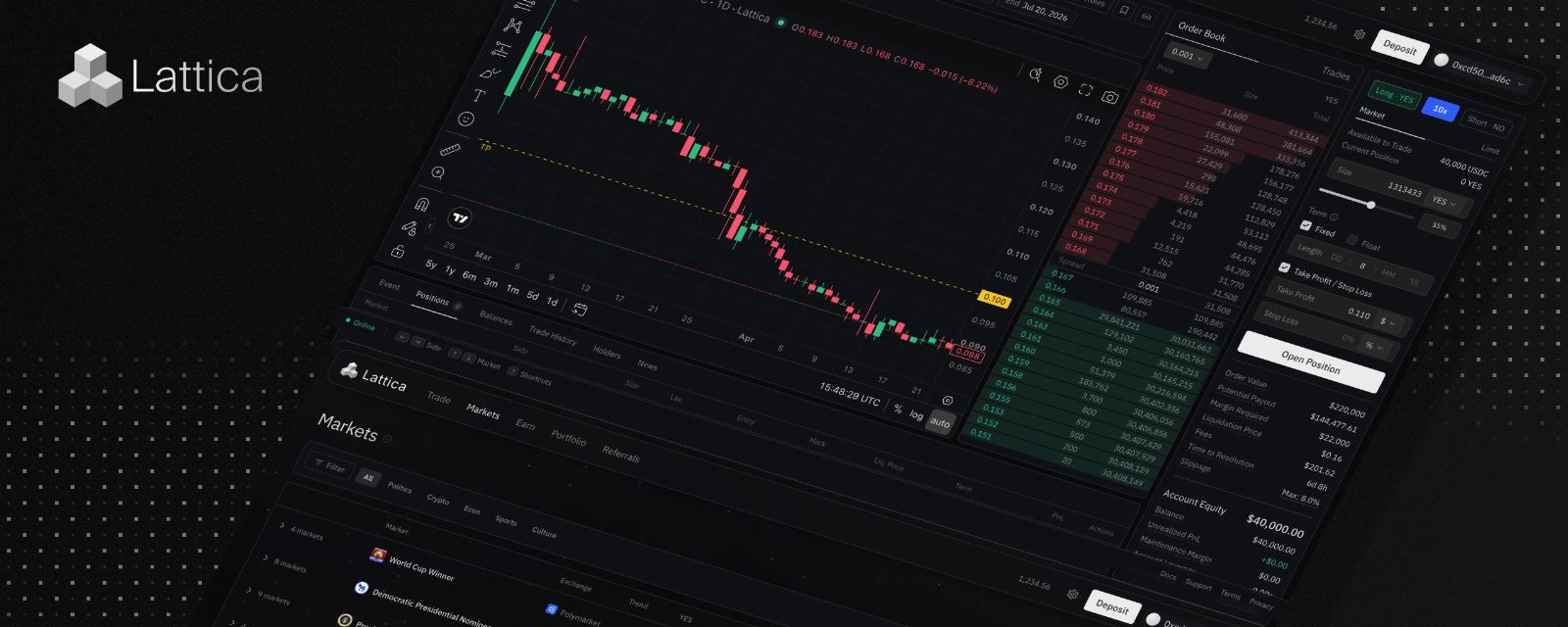
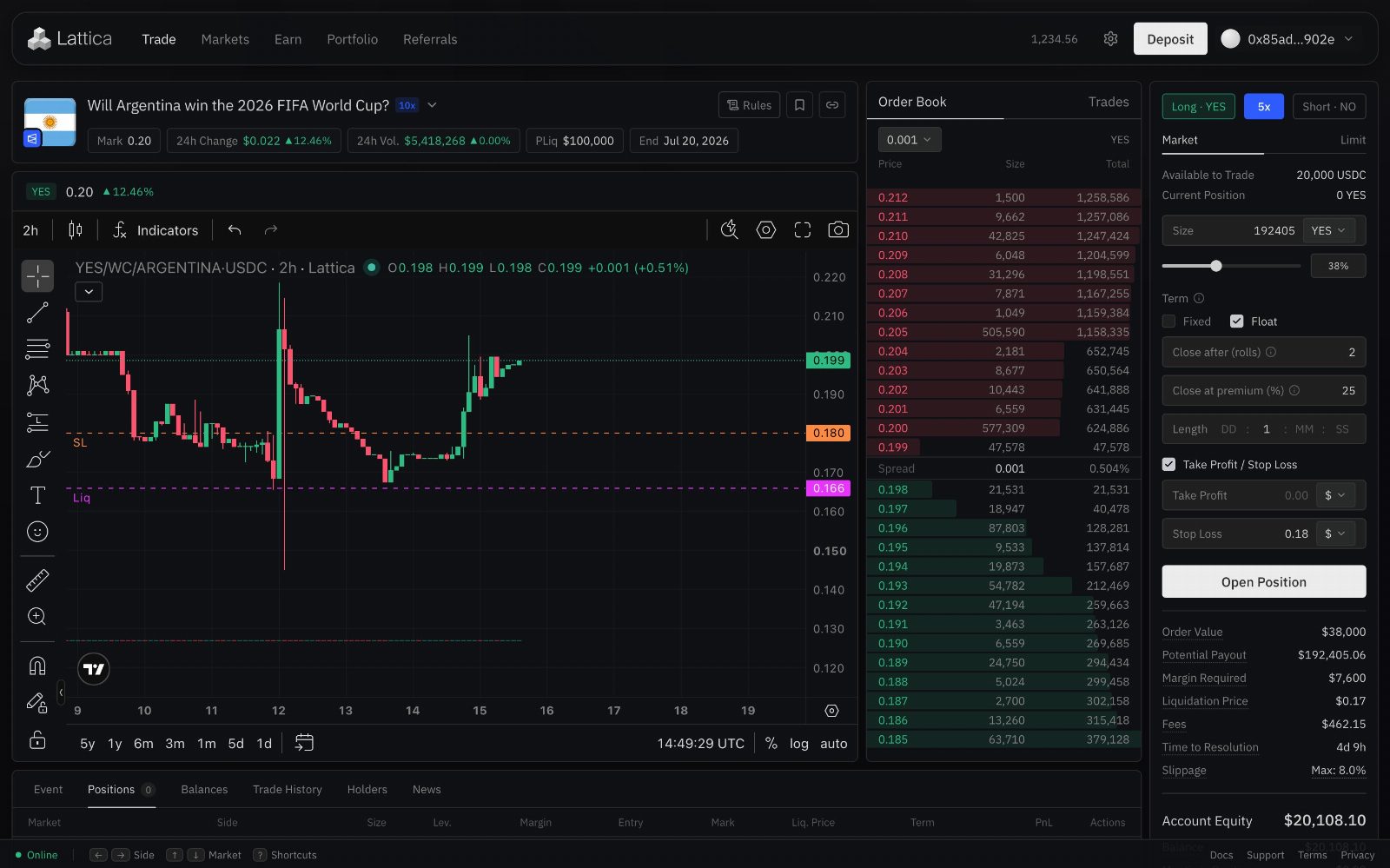
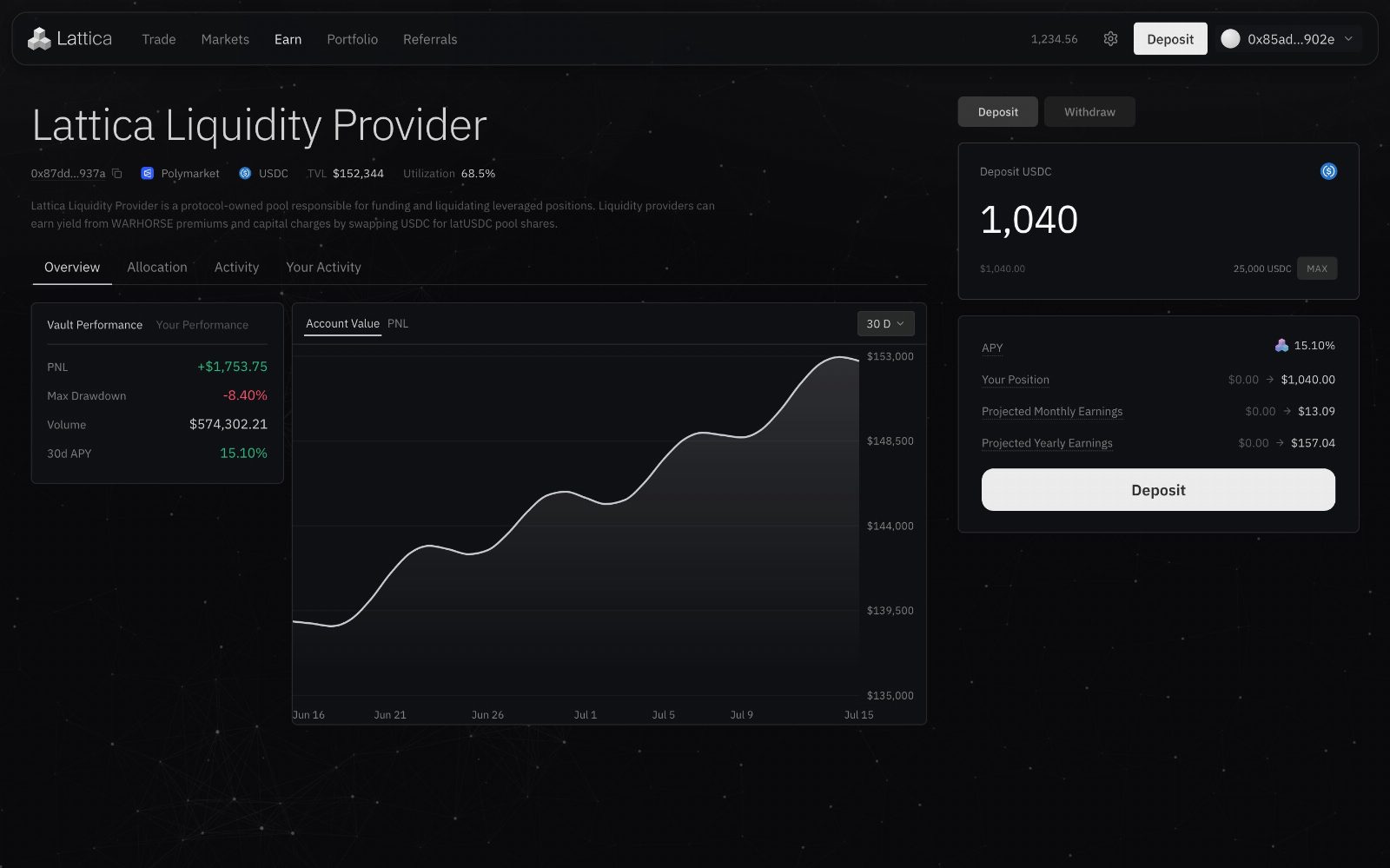
Lattica Review
Pros
- It lets traders open leveraged long or short positions on event outcomes with USDC margin.
- Holders can borrow USDC against outcome tokens without selling their exposure.
- The liquidation price is visible before a user confirms a position.
- The risk engine prices expected shortfall upfront instead of relying on liquidations to catch losses.
- Lenders earn yield from both fixed interest and risk premiums on every loan.
- Simulations on held out data showed the risk engine limiting maximum drawdown to low single digits.
- Fixed epochs with re-underwriting keep risk pricing current as markets move.
- The design works with any venue that issues ERC1155 conditional tokens.
- A protocol buffer sits ahead of the main lending pool in the loss waterfall.
- Published whitepapers and a public risk engine description allow independent evaluation.
Cons
- Access is waitlist only, so the contracts have no live track record.
- The risk engine was calibrated mostly on Polymarket data, so pricing on other venues is unproven.
- Premiums climb steeply near resolution and at high LTV.
- Leverage trades depend on an off chain permissioned role to acquire the position.
- Correlated markets need ongoing configurator management to contain shared risk.
- Users still carry smart contract and venue execution risk on top of market risk.
Our verdict
Lattica goes after a real problem: prediction market prices jump instead of drifting, and positions lock up capital until resolution, so ordinary lending protocols refuse to touch them. Its answer is to price that jump risk upfront through the WARHORSE risk engine instead of hoping liquidations arrive in time, and every loan gets repriced at fixed epochs so the numbers never go stale. Traders can open leveraged long or short positions up to 10x or borrow USDC against outcome tokens they already hold, while lenders earn yield from a single shared pool. The catch is that none of this is proven live yet: the protocol is still in early access via waitlist, the model was calibrated mostly on historical Polymarket data, and premiums get expensive exactly when markets get interesting, near resolution or at extreme prices. I would call it one of the more careful attempts at margin infrastructure for this asset class, worth the waitlist for active prediction market traders and stablecoin yield seekers who can stomach early stage contract risk.
Is Lattica safe & legit?
William Flanders and Stephen Flanders are the named founders, and they back the project with public technical papers and an open waitlist. There are no known red flags or public incidents, but Lattica has not launched yet, so its credibility rests on transparent research rather than a live track record in the Polymarket community. Treat it as early stage DeFi and size any exposure accordingly.
X account intel @Lattica
-
Based in United States
-
Joined X March 2026 6 months ago
-
Username changes 3 renames last on Aug 11, 2026
-
Signup source Web
Public profile signals from X. Use as one input alongside other due-diligence.
Security scan checked Oct 15, 2026
- Google Web Risk Not flagged
- MetaMask Not flagged
- Phantom Not flagged
- ScamSniffer Not flagged
- EtherAddressLookup Not flagged
- Keplr Wallet Not flagged
Domain lattica.finance checked against Google's lists of unsafe sites and public crypto wallet blacklists.
Lattica Updates
-
 10 of you are getting early access to Lattica.
Comment + repost to enter.- 17 replies
- 13 reposts
- 33 likes
- 818 views
-
never fade lattica.
1 more in this thread
Join waitlist ⬇️
https://lattica.finance/waitlist- 7 replies
- 12 reposts
- 51 likes
- 5.3K views
-
cooking with @PredictFolio data

- 10 replies
- 1 reposts
- 29 likes
- 1.6K views
-
Built for bigger positions.
1 more in this thread
Join the waitlist ⬇️
https://lattica.finance/waitlist- 4 replies
- 7 reposts
- 29 likes
- 1.2K views
-
Before it becomes obvious.
- 4 replies
- 5 reposts
- 28 likes
- 1.4K views
-
Many prediction markets simply aren't worth trading today.
You might spot a 3¢ edge, but with capped upside, the return isn't enough to justify the trade.
@Lattica is currently building one of the best tools to change that. From our talk with @SteveFlanders22 and @nicsickwilly- 4 replies
- 5 reposts
- 26 likes
- 1.1K views
-
History rewards perspective. Put yours to work.
- 7 replies
- 4 reposts
- 23 likes
- 1K views
-
ride your own wave.
- 2 replies
- 6 reposts
- 21 likes
- 1.2K views
-
Going to TOKEN2049 Singapore?
We’re hosting a curated Oktoberfest event on Oct 8 for the prediction market crowd.
Good beer, good food, and a chance to meet people across the space.
Spots are limited. Apply here ↓
https://luma.com/gptr5rfu- 10 replies
- 7 reposts
- 36 likes
- 2.8K views
-
Our smart contracts have been audited by @zenith256, with all findings resolved and fixes verified.
Thanks to the Zenith team for their thorough review as we prepare for launch.- 5 replies
- 7 reposts
- 21 likes
- 1.5K views
-
Size your conviction with Lattica.
- 1 replies
- 1 reposts
- 20 likes
- 1.8K views
-
We’re bringing Oktoberfest to #TOKEN2049 🍻
Together with @PredictFolio, we’re getting the prediction market crowd off the conference floor for an afternoon of German brews, good food, and even better conversations.
Limited spots. Singapore, Oct 8.
Join us ↓
1 more in this thread
@PredictFolio Free entry, food and drinks!
Sports are curated, so tell us what you're working on when you apply. We’re keeping the room tight and bringing together the best of the prediction market ecosystem.
Apply here: https://luma.com/gptr5rfu- 10 replies
- 7 reposts
- 56 likes
- 3.4K views
-
Together with our good friends at @Lattica, we're hosting a curated side event for prediction market fanatics during #TOKEN2049.
Join us for Oktoberfest2049!
Link below 👇
- 3 replies
- 5 reposts
- 16 likes
- 1.9K views
-
Built for those who see the gap.
1 more in this thread
Join the waitlist ⬇️
https://lattica.finance- 3 replies
- 3 reposts
- 37 likes
- 1.6K views
-
BREAKING NEWS: PredictFolio is now partnered with @Lattica to empower PredictFolio’s upcoming market intelligence with leveraged trading.
Building state-of-the-art products in the prediction-market ecosystem asks for collaborative efforts. We’re leading the way.- 11 replies
- 7 reposts
- 34 likes
- 5.2K views
Lattica Reviews & Comments
No reviews yet. Be the first to share your experience.
Lattica alternatives
Other Polymarket tools that do a similar job. Compare and pick what fits your workflow.
-
Compare
Kreo
Kreo copies proven Polymarket and Kalshi wallets in real time, so you ride smart money tr…
-
Compare
Polymarket
Traders buy and sell shares on real-world event outcomes, earning payouts when their pred…
-
Compare
Tailgate
Copy sharp bettors' plays at the best price across prediction markets, and get paid when…
-
Compare
Axiom Trade PolyMarket
Traders on Axiom can now take positions on real-world events without leaving the terminal…




Recommended reading
In-depth guides for Trading Terminals — get more out of tools like Lattica.
-
Tool Reviews
Best Polymarket Trading Bots 2026: Copy Trading & Sniper
Five Polymarket trading bots tested for 2026. Compare copy trading speed, sniper orders, fees after the March rate change, setup…
29 min read -
Tool Reviews
Best Polymarket CopyTrading Bot 2026
This breakdown covers the five best Polymarket bots available right now: PolyCop, Kreo, TradePolyBot, PolyGun, and a forward-look…
14 min read -
Tutorials
The Ultimate Guide to Copy Trading on Polymarket
Finding a profitable wallet is the easy half. This walks through picking one worth following, then setting the sizing, filters an…
6 min read


Ready to try Lattica?
Open the official site and get started in a few clicks.
Leave a comment