
Polybacktest

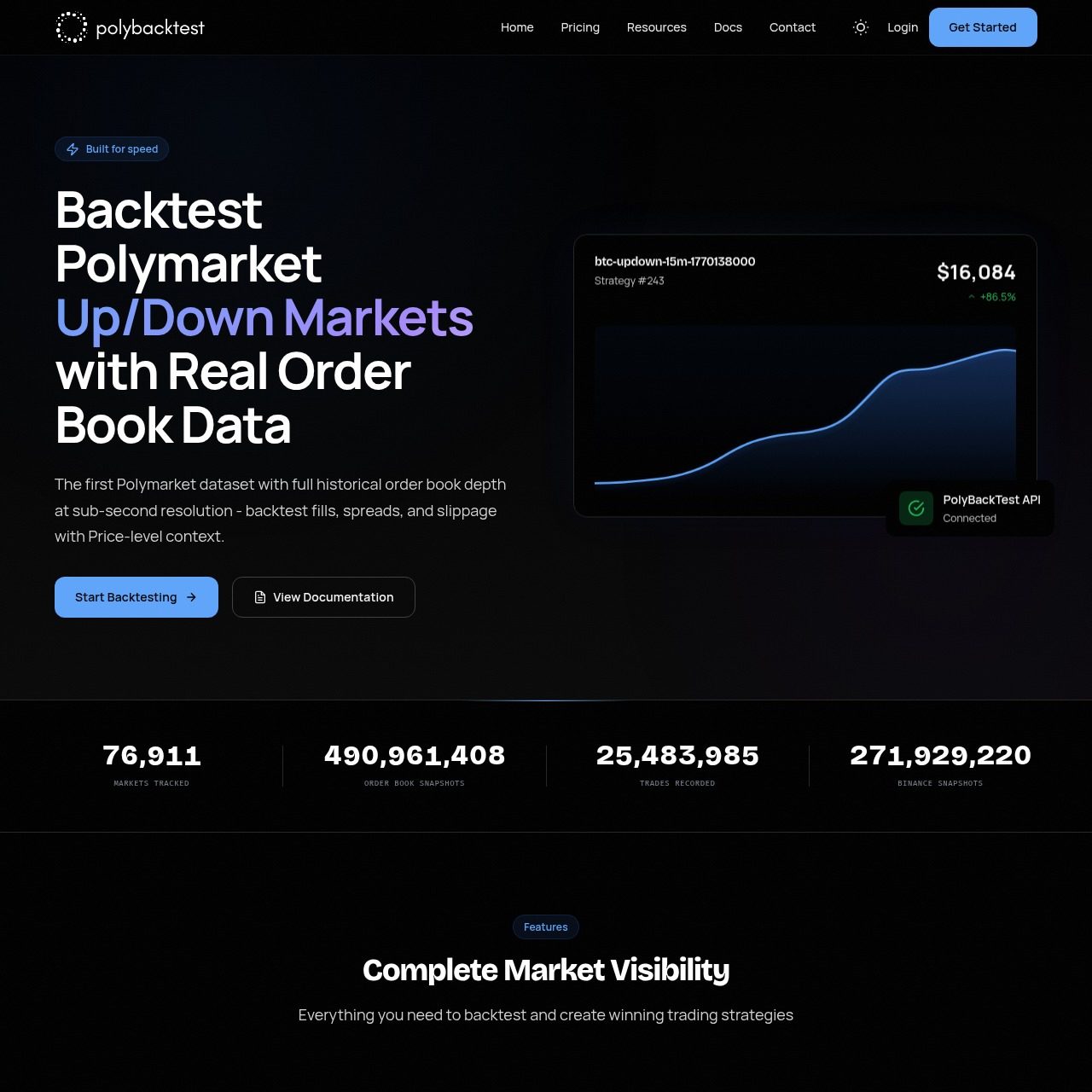
Polybacktest provides granular historical order book data to help traders simulate strategy performance on Polymarket with high precision.

Updated · Listed

What is Polybacktest?

Polybacktest provides high precision historical order book data and a REST API for traders to backtest strategies on Polymarket bitcoin and ethereum markets.

Polybacktest Overview

Traders use Polybacktest to run strategy simulations on Polymarket prediction markets. Users get full order book depth snapshots at sub-second intervals. The dataset contains bitcoin and ethereum up down token pairs. Users query historical moments or pull real-time data through a REST API or a Python SDK. They receive detailed bid and ask levels alongside aligned external price references.

Quantitative traders and bot developers use this API to test crypto event contracts. They validate their ideas before they commit real capital. This process helps them avoid losses from slippage and wide spreads. Researchers also use these detailed snapshots to study price discovery. Traders who build automated systems use the tool to test strategies frequently.

Most standard data feeds do not have the detail needed for realistic backtesting. Polybacktest archives complete order book states to solve this problem. The service keeps this data even after markets resolve. Traders replay exact market conditions to see how their orders execute with real liquidity. They get bitcoin and ethereum reference prices from sources that match Polymarket settlement rules. This alignment makes simulations accurate.

Jack Carroll launched Polybacktest in February 2026. It is an independent project with no official ties to Polymarket. The service is a research tool and processes payments through Stripe. Users can start with a free tier to test the API responses before they upgrade to a paid subscription.

Polybacktest Key features

  • Sub-second order book depth

    The service saves the full stack of bids and asks for up and down tokens at sub-second intervals. Traders use this data to calculate exact fill prices.

  • Historical data preservation

    The database stores complete order book snapshots long after markets resolve. Traders replay past market conditions to test their strategies.

  • Aligned reference prices

    The platform includes Bitcoin and Ethereum prices that match Polymarket settlement rules. Traders analyze how external price movements affect prediction token prices.

  • Python SDK support

    Developers use a ready-made Python library to fetch market metadata. This tool helps programmers focus on strategy logic.

Polybacktest Demo video

Polybacktest Screenshots
Polybacktest User Reviews

  • @monokern
    @monokern May 19, 2026

    The sub-second order book depth lets me simulate how my size moves the market on BTC contracts. I stopped guessing on slippage and burning capital. Now I iterate strategies in hours. The historical coverage on resolved markets provides the statistical validation I need. I recommend this to anyone building an edge.

    View on X ↗
  • @PolyDekos
    @PolyDekos May 18, 2026

    The API response times are fast. Having full bid and ask stacks aligned with reference prices makes backtesting feel realistic. I caught several strategies that looked profitable on charts but failed on actual liquidity. This saved me from deploying bots that would have lost money.

    View on X ↗
  • @polybacktest
    @polybacktest Mar 11, 2026

    Polybacktest provides sub-second historical data. It turned my vague ideas into numbers with real fill modeling. Anyone running bots on these up or down markets needs this level of granularity. It removes the guesswork around stale prices and liquidity impact.

    View on X ↗
✍️ Used Polybacktest? Share your experience — your review helps other traders decide. Write a review →

Is Polybacktest safe & legit?

Australian developer Jack Carroll created Polybacktest in February 2026. Active Polymarket traders trust the tool to test their strategies. The site has low traffic and a private domain registration, but users have reported no scams or security risks.

Wallet blacklist scan checked May 25, 2026

  • MetaMask Not flagged
  • Phantom Not flagged
  • ScamSniffer Not flagged
  • EtherAddressLookup Not flagged
  • Keplr Wallet Not flagged

Domain polybacktest.com checked against public crypto wallet blacklists.

Polybacktest Updates

  1. Polybacktest logo
    PolyBackTest
    60 days historical data now available for upgrade
    https://polybacktest.com/pricing
    • 2 reposts
    • 18 likes
    • 1.2K views
  2. Polybacktest logo
    PolyBackTest
    After BTC runs the same direction for 4 straight hours on Polymarket, bet the reversal. It hits 65%. And it works on ETH and SOL too.
    1,418 BTC, 1,437 ETH and 1,424 SOL 1-hour Up/Down markets. March 24 to May 22. We checked what happens after a streak of consecutive same-direction hours.
    After 4+ hours running one way, betting the reversal:
    BTC: 83 of 128 = 64.8%
    ETH: 87 of 140 = 62.1%
    SOL: 95 of 150 = 63.3%
    After 5+ hours:
    BTC: 62.2%
    ETH: 64.2%
    SOL: 61.8%
    Three different coins. Same signal. Same window. All landing 62-65%. When a signal shows up identically across three independent assets, it is far less likely to be noise than a single-coin backtest.
    Why 1-hour markets and not 5-minute? We tested the same reversal on 5-minute BTC markets. It gets destroyed, around 50%. Five-minute markets are momentum machines, swarming with bots. 1-hour markets give a real move time to exhaust itself. Four hours of one-directional grind is usually a trend running out of fuel, not a trend starting.
    The mean reversion shows up at the smaller threshold too. Previous hour moved more than 0.5%, bet the reversal: BTC 57.4%, ETH 54.3%. The bigger the prior move, the stronger the snapback.
    The honest caveat: 128-150 trades per coin is a solid starter sample, not a thousand-trade proof. And streak reversal is regime-sensitive. In a violent trending market, 4 hours up can become 8. The edge is mean reversion, and mean reversion dies in a runaway tape.
    But the cross-coin consistency is the thing. One coin at 65% is a maybe. Three coins at 62-65% on the same rule is a pattern worth trading.
    Test the 1-hour streak reversal across BTC, ETH and SOL at @polybacktest.
    • 3 replies
    • 12 likes
    • 1.4K views
  3. Polybacktest logo
    PolyBackTest
    "82% win rate, 15-minute window, 9am ET, February to March." We backtested the claim. It collapses on sample size.
    Start with the timeline. The 82% is from February to March. It is mid-May. That data is 2-3 months old. We have proven time-of-day edges decay in weeks. We found a 6am UTC bias worth 7.8%, re-tested it weeks later, completely gone. A window that printed in February tells you nothing about May. In our fresh data, 9am ET (13:00 UTC) leans slightly DOWN, not 82% UP.
    Now count the actual trades. He runs 3 filters before entering: macro sentiment, RSI, MACD. One trade per day. February to March is about 60 days. Three filters that each reject setups easily cut 60 candidates down to maybe 12-15 real entries. 82% of 15 trades is 12 wins. Flip a coin in clusters of 15 and you will find an 82% run almost every time. That is not an edge. It is a small sample with a confident caption.
    The 60% baseline is also inflated. He claims his general strategy wins 60% and this window lifts it to 82%. We have backtested thousands of BTC markets. Pre-market signals barely clear 50%. Buying the favorite at open wins 54-58%. Our strongest filtered edges, mean reversion in the exact right band, fade-the-pump, top out around 60% and then decay within weeks. A sustained 60% general win rate is the ceiling of what is provable, not a casual baseline. He starts the math from an inflated number and adds an inflated gap.
    The two filters doing the work do not work. We tested RSI and MACD directly on short BTC windows. RSI reversal: 47-49%. MACD crossovers: coin flips. They add zero predictive power. All they do is shrink the sample until a random streak looks like a system.
    And the exit. Buy at $0.50, sell at $0.80-$0.89 in 5-10 minutes. That assumes you reliably catch clean one-direction moves. Most markets do not move clean. We measured it: the typical BTC market's UP token swings in a $0.44 range during the window. You will not consistently buy the bottom and sell the top. You will get whipsawed.
    The post ends with a copy-trade bot referral link. That is what the 82% is actually selling.
    The honest version: a dozen filtered trades over a stale 2-month window hit a hot streak. Run it forward in May with real sample size and the 82% reverts toward the coin flip it always was.
    Before copying a time window from a thread, ask one question: how many real trades is the win rate built on? If 3 filters and 2 months leave you 15 trades, you do not have a strategy. You have a screenshot.
    Historical data, regimes shift. Test any window out-of-sample with an honest sample size at @polybacktest.
    • 2 replies
    • 3 reposts
    • 23 likes
    • 4.9K views
  4. Polybacktest logo
    PolyBackTest
    A thread is going around listing the "5 signals profitable Polymarket bots use." We backtested all 5 on 20,000+ BTC markets. Here's what holds up.
    Signal 1. Binance lead-lag of 1-3 seconds.
    Does not exist. We measured 32,832 price events at 100ms resolution. Polymarket reprices in the same window Binance moves. Buy on a Binance move, sell 1 second later: profitable 30% of the time. The lag died in 2024.
    Signal 2. Spot distance from strike.
    Real. At 55 seconds left with BTC up 0.10%, the winner hits 99.1%. But the token already costs $0.96. Gross profit: 4 cents. After Polymarket fees, spread and gas: ~2 cents. A 99% win rate that nets 2 cents is unpaid labor.
    Signal 3. Previous candle direction.
    50.1% across thousands of markets. A coin flip. Add a fee and it's negative EV. Not a signal.
    Signal 4. Day and hour edges.
    Real, but they decay in weeks. We found a 6am UTC bias worth 7.8%. Re-tested later: gone, 49.2%. A bot hard-coded to a stale time slot just pays fees to lose.
    Signal 5. CLOB momentum and contrarian.
    Both land at 49-51%. The contrarian version hits ~53% after a 3+ streak. But 53% gross is breakeven once fees, spread and gas come out.
    The scorecard: one signal is false, two are coin flips that go negative with fees, one decays in weeks, one is real but fee-eroded to 2 cents.
    The part every "profitable bot" thread skips: on a near-coin-flip market, the platform fee IS the game. A signal has to clear 50% plus fee plus spread plus gas before it earns a dollar. Most of these don't clear 50% at all.
    "Simple beats complex" is correct. But simple doesn't mean profitable. A simple bot on a signal that doesn't exist is just a simple way to lose money.
    Test any signal out-of-sample, fees included, before you deploy a dollar at @polybacktest.
    • 8 replies
    • 4 reposts
    • 53 likes
    • 9.3K views
  5. Polybacktest logo
    PolyBackTest
    How fast can you go broke playing double-or-nothing on Polymarket? We ran the math on 14,502 BTC markets. The answer is faster than you think.
    Double-or-nothing: bet your entire stack at $0.50, a win doubles it, a loss zeroes it. Roll everything into the next trade. The fantasy is $10 to $10,000 in 10 wins.
    Here's reality. Always bet UP, roll the whole stack:
    48.9% of players bust on the very first trade.
    75% are broke within 2 trades.
    94% are gone by trade 5.
    Average number of trades survived before going to zero: 1.01.
    Out of 7,206 double-or-nothing runs in the data, the longest anyone survived was 15 trades in a row. That happened exactly once. One time in 14,502 markets.
    "But I'll use a high win rate strategy," you say. Fine. Let's give you a 99% win rate. The late-entry strategy, buying the near-locked winner. Bet your entire bankroll every time.
    Survive 10 trades: 90.4%
    Survive 25 trades: 77.8%
    Survive 50 trades: 60.5%
    Survive 69 trades: 50.0%
    Survive 200 trades: 13.4%
    Survive 500 trades: 0.7%
    Even at a 99% win rate, betting all-in, half of all players are wiped out by trade 69. Run it long enough and the bust is not a risk. It is a certainty. The 1% loss finds everyone eventually.
    We simulated it. Median peak bankroll an all-in 99% bettor reaches before the bust: $175. Started with $10, touched $175, went to zero. That is the typical story.
    Now the fix. We ran the same 99% strategy but betting a FRACTION of the bankroll instead of all-in:
    Bet 100% per trade: busted 99% of the time. Median final balance: $0.
    Bet 50%: busted 0%. Median after 500 trades: $9,175.
    Bet 25%: busted 0%. Median: $418.
    Bet 10%: busted 0%. Median: $47.
    Same strategy. Same 99% win rate. Same market. The only variable is bet sizing. All-in goes to zero. Half-stack turns $10 into $9,000.
    The math no thread will tell you: it is never the strategy that bankrupts you. It is the sizing. A losing strategy with good sizing bleeds slowly. A winning strategy with all-in sizing dies on schedule. The bust is not bad luck. It is arithmetic.
    Model your own ruin curves and bet-sizing survival rates at @polybacktest before you roll a single trade.
    • 12 likes
    • 1.3K views
  6. Polybacktest logo
    PolyBackTest
    Some Polymarket markets decide in the first 30 seconds. Others take the full 5 minutes and still feel random. We measured both kinds.
    315 BTC 5-minute markets with 100ms snapshot data. We counted how many times the favorite flipped during each market. UP leads, then DOWN leads, then UP again. Each flip is a moment the market couldn't make up its mind.
    Average flips per market: 4.3
    Markets with zero flips (one direction the whole way): 78
    The cleanest split. What percent of the 5-minute window was the EVENTUAL WINNER actually in the lead?
    Monotonic markets (0-2 flips): winner led 88.7% of the market time. 156 markets.
    Mid markets (3-9 flips): winner led 71.9%. 87 markets.
    Oscillating (10-19 flips): winner led 71.4%. 42 markets.
    Heavy oscillation (20+ flips): winner led 45.1%. 4 markets.
    When the market settles into a direction early and stays there, the favorite is right 88.7% of the time. The market knew at minute 1.
    When the market flips 20+ times across 5 minutes, the winner actually led LESS THAN HALF the time. The favorite at any given moment was wrong more often than right. These are markets that resolve essentially by Chainlink coin-flip timing.
    The token price range tells the same story.
    25th percentile market: UP token oscillates within a $0.27 range.
    75th percentile: $0.44 range.
    90th percentile: $0.52 range.
    In 1 of every 10 markets, the UP token swings from below $0.30 to above $0.80 and back during the 5 minutes. Those are the markets where you can buy in confident at minute 2 and still lose.
    UP rate stays at 51% regardless of oscillation level. There is no directional bias in chaotic markets. They are not "biased DOWN" or "biased UP." They are just unpredictable. The market itself is broadcasting that uncertainty through the flip count.
    The trade: count favorite flips in the first 90 seconds. If the count is 0-1, the favorite is a 75-90% lock. If the count is 5+, walk away. Don't try to read who's winning at minute 2 when the market has already flipped 5 times. It's going to flip again.
    This is one of the few signals on Polymarket that filters BAD trades rather than picking winners. Most strategies tell you which side to take. This one tells you whether to take a side at all.
    Track favorite flip counts in real time at @polybacktest.
    • 1 replies
    • 3 reposts
    • 52 likes
    • 4.5K views
  7. Polybacktest logo
    PolyBackTest
    You can predict Polymarket BTC markets with a single number. The gap between UP and DOWN at open. We tested 1,499 markets.
    The setup. At market open, both tokens have a price. UP might be at $0.55, DOWN at $0.47. The spread is $0.08. The bigger that spread, the more the market is leaning one way.
    We measured the favorite's win rate by opening spread:
    Spread $0.005-$0.020 (tight): 48.8% favorite WR. Coin flip.
    Spread $0.02-$0.04: 49.3%.
    Spread $0.04-$0.06: 59.8%.
    Spread $0.06-$0.08: 53.7%.
    Spread $0.08-$0.12: 55.4%.
    Spread $0.12-$0.20: 58.7%.
    Spread $0.20-$0.50: 67.3%. 211 markets.
    The relationship is monotonic above $0.04. The bigger the gap, the more reliable the favorite.
    Cumulative: when spread >= $0.20 at open, the favorite wins 67.3% of the time. Across 211 markets. That's a 17-point edge over a coin flip from a single observable variable at the moment the market opens.
    What's the simplest possible strategy? Buy the favorite when the opening spread exceeds a threshold.
    Spread >= $0.05: 1,063 trades, 59.2% WR, EV +$0.27 per $10
    Spread >= $0.10: 605 trades, 61.7% WR, EV +$0.21 per $10
    Spread >= $0.15: 360 trades, 65.3% WR, EV +$0.43 per $10
    Spread >= $0.20: 211 trades, 67.3% WR, EV roughly +$0.50 per $10
    The thicker spread filters fewer trades but the per-trade EV climbs.
    Why does this work? The opening spread is information density. Tight spreads ($0.50/$0.49) mean the market makers haven't taken a side yet. Bots are quoting wide and waiting. Wide spreads ($0.65/$0.30) mean BTC has already moved meaningfully in the pre-window, the orderbook has tilted, and that tilt usually persists.
    The caveat. These are mid-prices. Real execution at the ask gives back 1-2 cents per trade. The $0.20 spread bucket might still be profitable after frictions because the per-trade edge is large. The $0.05 bucket likely breaks even.
    The pattern is also regime-sensitive. In a strongly trending market, even tight spreads can favor one direction systematically. In a chop, big spreads can fake out. Re-test weekly to see which spread band still has edge.
    Stream opening spreads in real time and bucket by hour and coin at @polybacktest.
    • 4 replies
    • 2 reposts
    • 69 likes
    • 7K views
  8. Polybacktest logo
    PolyBackTest
    We filtered Polymarket BTC markets to ONLY the ones that looked like coin flips at open. Token price between $0.47 and $0.53. We found two hidden biases nobody is pricing.
    587 BTC 5-minute markets with opening token prices in the $0.47-$0.53 range. The "I don't know what's going to happen" markets. The ones the algorithms agree are 50/50.
    Overall UP rate in these markets: 50.9%. Boring. Coin flip confirmed at the aggregate level.
    Then we sliced by hour.
    15h UTC: UP wins 82.1%. 28 markets.
    19h UTC: 64.0%. 25 markets.
    14h UTC: 62.5%. 32 markets.
    12h UTC: 59.3%. 27 markets.
    15h UTC is wild. When the market opens uncertain at 3pm UTC, UP wins 82% of the time. That's a 32-point edge in a market that the algorithms said was 50/50.
    In the tighter $0.48-$0.52 band: 15h UTC hits 83% UP across 24 markets. Same pattern, smaller sample, stronger signal.
    Then we sliced by what BTC actually did.
    When BTC moved more than 0.05% during the market: UP wins 48.8%. Coin flip.
    When BTC moved less than 0.02%: UP wins 62.8%. 113 markets.
    When BTC moved less than 0.01% (basically a tie): UP wins 68.3%. 60 markets.
    The closer the market is to a tie, the more UP wins. This is mechanical, not directional. The Chainlink price feed reads BTC at a specific microsecond. When BTC oscillates around the threshold, the Chainlink read happens to land on the UP side more often than chance.
    Two takeaways:
    Trade only coin-flip markets at 15h UTC. Bet UP. 82% WR on 28 markets is a meaningful starter sample, not a lock.
    When BTC has barely moved with 30 seconds left and both tokens are near $0.50, the cleanest bet is UP. There's a structural Chainlink-timing edge that favors the upside in near-tie resolutions.
    Both biases are invisible if you look at the full market. They only appear when you filter to the uncertain ones. The 50/50 markets are not actually 50/50.
    Important caveat: this dataset spans a stretch where BTC was mostly trending up. A coin-flip-market UP bias at 15h UTC could partly be the macro tape leaking into the micro structure. In a downtrend regime, that 82% could collapse or invert. The 15h UTC slot also sits inside the US pre-open window, so flow patterns there shift as institutional sentiment shifts week to week.
    The actually durable edge isn't "always bet UP at 15h." It's the workflow: filter to coin-flip markets, slice by hour, watch the bias each week, turn the strategy on when the bias holds and off when it flips. The data tells you which regime you're in if you check it.
    Historical data, regime-dependent. Filter Polymarket markets by opening price range and re-slice every few days at @polybacktest.
    • 2 replies
    • 1 reposts
    • 33 likes
    • 4.3K views
  9. Polybacktest logo
    PolyBackTest
    Stop losing money on the 5-min BTC market. We backtested the exact thresholds this trader is selling. Most of his math is wrong.
    12,234 BTC 5-minute markets through May 16. Real Polymarket token prices. Real Binance second-level data. The "$10 unsafe, $25 safe" threshold he describes is approximately correct.
    Win rate by BTC move size at T-55s:
    Move >0.02% ($16 at $80K BTC): 88.9% WR
    Move >0.05% ($40): 94.3% WR
    Move >0.10% (~$80): 99.1% WR
    The threshold is real. But it's a percentage, not a dollar amount. A $25 gap at $40K BTC is twice the move it is at $80K BTC. His rule breaks down when BTC price level shifts.
    The "last-second flip and bounce back" he describes also exists. We found 123 markets in 12,234 where BTC was clearly one direction at minute 4 but resolved the opposite way. 17 of them had loser tokens priced at $0.10 or below that actually won. About 1% of markets. Rare, not constant.
    Now the math he hides.
    At T-55s with BTC moved >0.10%, the winning token costs $0.96. Your profit per win is $0.04. Your loss per loss is $0.96. The actual EV:
    99.1% WR × $0.04 - 0.9% × $0.96 = $0.034 profit per $0.96 staked. Roughly 3.5% per trade.
    Not 10%. Not even close.
    He frames this as turning $100 into $10,000. 100x compounding needs ~134 perfect trades in a row. The longest win streak we found in 12,234 markets: 15 trades. The math says $10K is impossible at this strategy's EV. The math says you can grind 3.5% per trade with discipline.
    The price gap observation is real. The Claude-as-devil's-advocate framing is decent psychology. The 100x return goal is fantasy bait wrapped around a 3% edge.
    The actually useful version of his post: there's a small structural edge in waiting for clear gaps before entering. The edge is razor thin. It works if you can size correctly and accept one loss eats ~24 wins.
    Run the threshold yourself with real tick data and orderbook snapshots at @polybacktest.
    • 4 replies
    • 6 reposts
    • 61 likes
    • 9.4K views
  10. Polybacktest logo
    PolyBackTest
    Go to https://polybacktest.com
    • 2 reposts
    • 6 likes
    • 9.5K views

Polybacktest Reviews & Comments

No reviews yet. Be the first to share your experience.

Leave a review

Rating
optional

Ready to try Polybacktest?

Open the official site and get started in a few clicks.

Launch Polybacktest