
Polymarket Builders Program: How Developers Earn From Routed Trading Volume
A clear guide to the Polymarket Builders Program. Learn how builder codes, builder fees, and weekly USDC rewards pay developers for routed prediction market volume.


If you build a trading bot, a cleaner interface, or any tool that helps people place bets on Polymarket markets, you can now get paid for the volume you send through. The Polymarket Builders Program turns order routing into a revenue line instead of unpaid contribution.
The mechanics are direct. You attach a unique code to every order that passes through your app. When those orders match, you earn. Some builders charge their own fee on top. Others collect from a weekly USDC pool that grows with total attributed volume. Grants sit above both for teams with real traction.
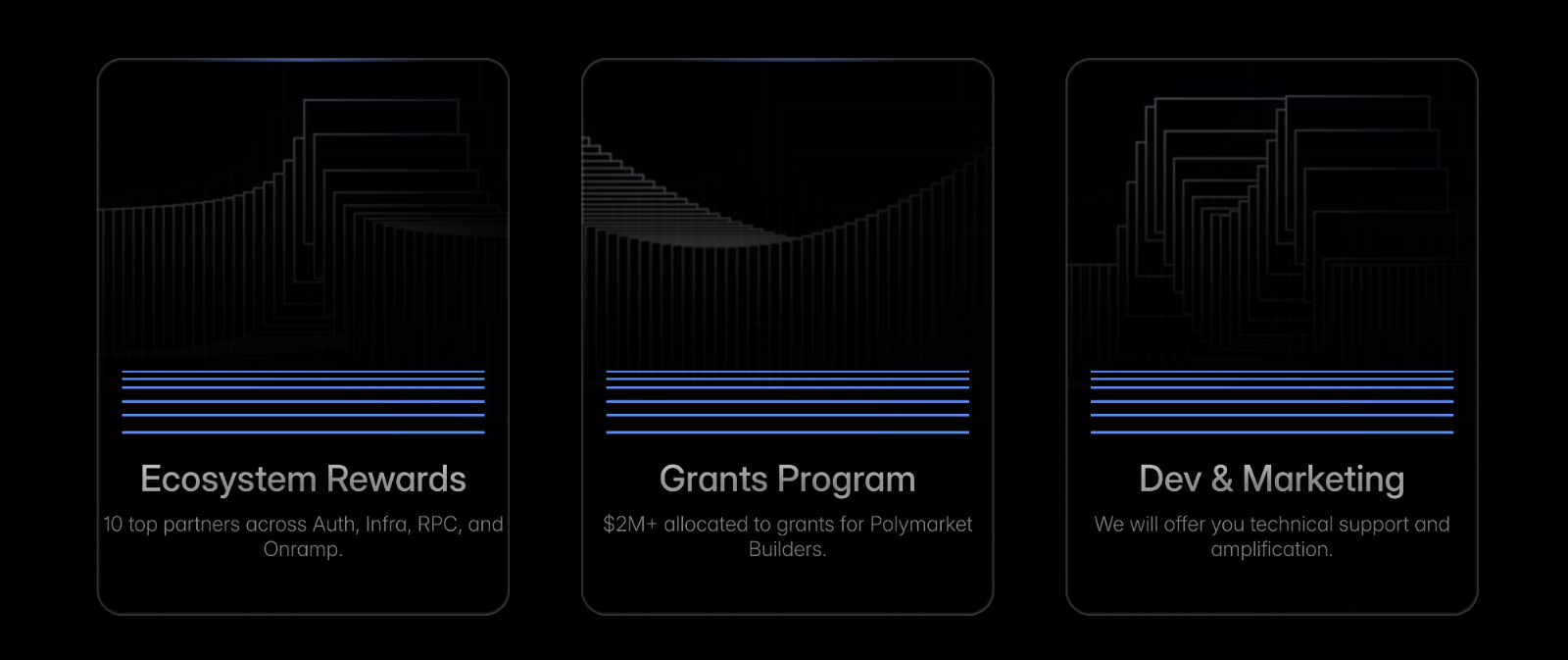
This is live, not a plan. Apps are already routing hundreds of millions of dollars through the program, with public leaderboards and on-chain records of who drives what.
What the Polymarket Builders Program Pays
The program has three earning layers, and you can use one or all of them.
- Builder fees you set yourself, charged on maker and taker orders routed through your code. These settle to the wallet tied to your builder profile.
- Weekly USDC rewards split by your share of total attributed volume. The pool started on November 2nd, 2025, with reward epochs running Sunday 00:00 UTC to Saturday 23:59 UTC.
- Grants from a $2.5 million fund for teams that show product traction, not only raw volume.
You also get a public builder badge, a spot on the leaderboard at builders.polymarket.com, and access to the Relayer for gasless flows. Everything runs on Polymarket's CLOB V2 matching, so liquidity stays the same as the main site.
The thing that separates a builder from a plain frontend is attribution. Without the code, your users' trades earn you nothing. With it, every matched order gets credited to your profile on-chain.
How Builder Fees Work
Your builder profile holds two rates you control.
| Fee type | Maximum rate | Charged on |
|---|---|---|
| Taker fee | 100 bps (1%) | Orders that fill immediately |
| Maker fee | 50 bps (0.5%) | Resting orders that later fill |
Builder fees are additive. They never replace Polymarket's own platform fees, so a user pays both when a code is attached. Your fee comes off the notional size of the trade and accrues to your wallet after each match.
Here is what a single trade pays you.
| Trade | Your rate | Your fee |
|---|---|---|
| $10,000 taker order | 50 bps | $50 |
| $5,000 taker order | 100 bps | $50 |
| $10,000 maker fill | 30 bps | $30 |
Rate changes are gated so users see them coming. You can make one change per 7 days, and a scheduled change takes effect 3 days later. You can hold only one pending change at a time, so plan ahead before you adjust.
Fees Land Only on Matched Trades
Open orders that never fill pay you nothing. That is why real execution matters more than signup counts. A user who places ten orders and fills two earns you fees on two.
Weekly Rewards and Grants
Even with fees set to zero, steady volume still earns you a slice of the weekly USDC pool. Polymarket has not published the exact split. PolyTrack, an analytics site that tracks builders, estimates the rate at 0.5% to 1% of attributed volume, back-calculated from one builder's public figures. Based, a top-ten builder by volume, reported around $1 million in annualized recurring revenue from rewards alone.
Grants are separate and not automatic. They go to teams with a working product and active users. If you have traction or a clear plan to bring traders in, an application is worth the time.
How to Get Your Builder Code
Setup takes about five minutes and needs no approval.
- Sign in at polymarket.com.
- Open Settings and go to the Builder tab (polymarket.com/settings?tab=builder).
- Create your builder profile.
- Copy your bytes32 builder code. It starts with 0x and is public.
- Set your maker and taker rates on the same page if you want to charge fees.
That code handles basic attribution on its own. For gasless transactions, pull your API credentials from the same page and use them with the official builder-relayer-client.
Adding Builder Codes to Bots and Apps
Most active builders fall into a few groups: Telegram bots for copy trading or fast entries, pro terminals with better order types, embedded experiences inside wallets, and analytics dashboards.
The integration path is short. Use the CLOB V2 SDK in TypeScript or Python. When you create and post an order, pass the builderCode parameter. The SDK writes it into the signed V2 order struct, so the code is part of the order itself, not an off-chain label.
const response = await client.createAndPostOrder(
 { tokenID: "0x123...", price: 0.55, size: 100, side: Side.BUY, builderCode: process.env.POLY_BUILDER_CODE },
 { tickSize: "0.01", negRisk: false },
 OrderType.GTC,
);
The code travels with every order, gets validated by the CLOB, and appears in the builder field of each OrderFilled event. After a match, the Builders Service reads those events and credits the volume and fees to your profile. Volume can take up to a day to show on the leaderboard, so do not worry if it lags.
For smoother onboarding, add the Relayer Client. It handles wallet deployment, token approvals, and order execution so users skip gas. Open examples for Magic, Turnkey, and Safe show the common patterns.
A missing or malformed code is not an error message. It means those trades count for nobody. Test your order flow before you ship.
What the Volume Looks Like

The numbers moved fast. Builder-attributed volume grew from about $100 million in November 2025 to over $600 million by March 2026, roughly 16% of Polymarket's total trading. The program drew around 200 developers in its first months.
The spread between builders is wide. Across the top 50 by cumulative volume, the Gini coefficient sits at 0.83, which is closer to winner-take-all than to a level field. One anonymous app, Betmoar, processed around $817 million while staying off the press entirely. Most listed projects sit under $1 million in volume.
One caveat on the headline figures: Paradigm has shown the public leaderboard overstates one-sided flow by about 2x, so read absolute dollar numbers with that in mind.
The Scrutiny Builders Should Know About
The Polymarket Builders Program drew real heat in 2026, and you should account for it before you build.
Several early apps focused on copy trading, mirroring wallets with high win rates for a subscription fee. Polymarket opened a review and audited startups including Polycool and Kreo after some marketed tools for copying suspected insider activity. The company brought in Palantir for compliance monitoring. Reporting from the Wall Street Journal flagged fake bets used in some promotions, and at least one exchange moved to restrict accounts tied to prediction markets.
Polymarket's own terms let it revoke your fee privileges at its discretion, including for self-referred or non-genuine trading. A disabled code gets its orders rejected by the CLOB. The lesson is plain. Build for real user value and sustainable activity, and you stay in good standing.
Should You Build on It?
It comes down to whether you can bring and keep real trading activity.
A landing page or a demo with little usage earns little. The program pays output, not ideas. If you already have users placing trades, or a clear path to bring them in through better mobile execution, specific automation, or stronger analytics, the math works. Adding the builder code costs almost nothing, and the revenue scales with your traction.
Treat it as infrastructure. You build the tool traders want, you route every order with attribution, and you collect the economics on top.
Start With the Polymarket Builders Program Today
Claim your builder code now at polymarket.com/settings?tab=builder. Set low or zero fees while you test flow, then raise them within the cooldown rules once users stick around. Read the order attribution and Relayer docs, wire the code into every order, and track your attributed volume through the SDK. If your tool has real usage, apply for a grant.
Build something traders use, attach the code, and collect what your volume earns. That is the offer the Polymarket Builders Program puts on the table.


