

Marketlens
Quant traders and bot builders get millisecond-level Polymarket order book data and a realistic backtesting engine to test strategies before risking capital.

MarketLens: Order Book Data and Backtesting for Polymarket
What is Marketlens?
MarketLens is a Polymarket data and backtesting platform that gives quant traders and bot builders millisecond order book history, realistic execution simulation, and probability signals through a Python SDK and API.
Ready to try Marketlens?
Open the official site and get started in a few clicks.
Marketlens Overview
MarketLens gives Polymarket traders and researchers historical Level 2 order book data, executed trades, derived signals, and a full backtesting engine. Instead of just showing current odds, it stores every book update at millisecond resolution and lets you replay it with real execution rules like latency, queue position, fees, and settlement. This solves a real gap on Polymarket, where public tools and the official CLOB only give you current state or short history. MarketLens keeps continuous order book snapshots from March 2026 onward across hundreds of thousands of markets.
The tool is built for people who need exact fill data, not simple charts. That means quant traders, bot builders, researchers studying market microstructure or implied probability, and teams testing signals before they risk real money. It also supports agent workflows through an MCP server, so AI agents can search markets, pull order book data, and run backtests through natural language commands. Casual traders who just want price alerts or basic charts will not get much use out of it. Data coverage focuses on recurring series only, like weather highs and lows, sports leagues, crypto up/down markets, multi strike prices, barrier hits, and macro events such as GDP or rate decisions. One off event markets are left out on purpose, so backtests stay consistent across similar market instances.
Access works through an open source Python SDK or a REST API at api.marketlens.trade/v1. You create an API key, install the package with pip, and write a strategy class that plugs into one of two backtesting engines. The Execution engine runs tick by tick with queue modeling and partial fills for precise simulation. The Alpha engine runs on bar intervals for faster testing across weeks or months. Both return full metrics like PnL, Sharpe ratio, and drawdown, along with data you can inspect in an interactive dashboard.
What sets MarketLens apart is the depth of its order book replay and its focus on real fill conditions instead of simplified mid price assumptions. Add in implied probability surfaces, reference prices from Binance for crypto markets, and support for offline caching and portfolio backtests, and it becomes one of the few tools built specifically for serious strategy work on Polymarket rather than casual browsing.
Marketlens Key features
-
Millisecond order book replay
MarketLens stores every book level and update without interpolation, so users rebuild the exact order book at any timestamp. This lets traders test limit orders and market order impact against real conditions.
-
Two backtesting engines
The Execution engine runs tick by tick with latency, queue position, and fee rules that match Polymarket. The Alpha engine works on bar intervals from one second to one day for faster signal research.
-
Probability surfaces and signals
MarketLens fits implied distributions, survival curves, and barrier surfaces for multi outcome markets, and refreshes them every few minutes. Binance spot candles for crypto assets add correlation and distance based filters.
-
Market discovery and hierarchy
Users search and filter markets by liquidity, volume, category, or series, then move through events to find sequential instances of the same product. Raw data exports to Parquet files for offline work.
-
Book and trade analytics
The tool computes micro price, weighted mid, spread in basis points, imbalance, and slippage estimates. Full trade history and OHLCV candles are available at any resolution a user picks.
-
Offline caching and portfolios
Users download series data once and reuse it across runs, then test strategies on single markets, full series, or portfolios with shared capital. Results include PnL, Sharpe, drawdown, and win rate, plus a dashboard to view them.
-
MCP server for agents
Local stdio tools let AI agents search markets, query order books, and run backtests through clients like Claude Code or Cursor. Computation stays under the user's own API key.
-
Self healing data collection
MarketLens checks its books against Polymarket's official CLOB and reseeds data automatically when it detects drift. Redundant connections keep the data feed running without gaps.
-
Open source Python SDK
The SDK is MIT licensed and published on GitHub and PyPI, so users can inspect the code and run it locally after downloading data. Frequent versioned releases show active maintenance.
-
Recurring series coverage
MarketLens tracks weather, sports, crypto binaries, multi strike, barrier, and macro markets, but only recurring series, not one off events. This design choice keeps backtests consistent across repeated market instances.
Marketlens Fees
-
Subscription tiers MarketLens charges monthly or annual subscription tiers, and every tier unlocks the same data endpoints and backtesting features.
-
Annual discount Annual plans include three free months compared to paying monthly.
-
Exact pricing hidden Exact dollar amounts and rate or volume quotas only show up after you log into the console.
-
Usage limits Limits apply per user and add up across all API keys, with no extra per-query charges mentioned beyond the plan limits.
-
Backtest fee simulation The backtesting engine can apply Polymarket-style fees for crypto and sports markets, or run with zero fees for pure research.
Marketlens Supported networks
 Polygon
How to use Marketlens
-
Create your account
Sign up on the MarketLens console and generate an API key. You will need this key for every request the SDK or REST API makes.
-
Install the package
Run pip install marketlens on Python 3.10 or higher. This gives you the SDK and the Strategy base classes.
-
Set your API key
Export the key as MARKETLENS_API_KEY in your environment, or pass it directly to the client constructor when you set up your script.
-
Import the SDK
Import MarketLens along with the Strategy or AlphaStrategy base class, depending on whether you want tick level execution or bar based research.
-
Write your strategy
Define a strategy class and implement the callbacks it needs, such as on_book or on_market_start. These callbacks tell MarketLens how your strategy reacts to market data.
-
Run a backtest
Create the client and call backtest with your strategy, a market or series identifier, a time window, and starting cash. Add a data directory if you want to cache the data for reuse.
-
Check your results
Open the result object to see metrics like PnL, Sharpe, and drawdown. Save the run or open the interactive dashboard to look at trades and equity curves in more detail.
-
Pull data directly
Skip the strategy step if you only need data. Use client.markets.list, the orderbook methods, trades, candles, signals, or exports.download_series to work with raw market data.
-
Enable agent access
Install the mcp extra and start the local MCP server if you want tools like Claude Code or Cursor to search markets, query order books, and run backtests on your behalf.
Marketlens Screenshots
Marketlens Review
Pros
- It replays order book data at millisecond resolution with real latency and queue rules, so backtests do not rely on simplified mid price fills.
- The Python SDK is open source under the MIT license, so users can inspect the code and run it offline after downloading data.
- It covers recurring series across weather, sports, crypto, multi strike, barrier, and macro markets, which supports systematic testing across many market types.
- It offers two backtesting engines, one for tick by tick execution accuracy and one for faster bar based signal research.
- It provides fitted probability surfaces and density curves for multi outcome markets, which basic CLOB clients do not offer.
- The MCP server lets agents like Claude Code or Cursor search markets and run backtests while the API key stays local.
- The team ships frequent package updates and posts original microstructure research on X, showing active maintenance.
- It verifies collected order books against the official Polymarket CLOB and reseeds automatically when data drifts.
- Users can export raw data as Parquet files and cache it locally to avoid repeated downloads.
- It computes ready made analytics like micro price, spread in basis points, and slippage estimates directly from the stored book data.
Cons
- Historical data starts only in March 2026, so long lookback studies are not possible.
- One off event markets are excluded, leaving gaps for unique or single instance events.
- Exact prices and rate limits stay hidden until after signup, making cost comparison hard upfront.
- No public team roster or company registration info exists to verify who runs the platform.
- The platform has no live trading or wallet features, so it cannot execute real orders.
- The X account and third party reviews are sparse, so users must judge data quality on their own.
- Using the tool needs Python skills or agent setup, since there is no plain graphical interface besides the dashboard.
Our verdict
MarketLens gives you something almost nobody else offers for Polymarket: real tick level order book history you can actually replay, down to the millisecond, with fees, latency, and queue position built in instead of guessed at. The dual engine setup makes sense once you use it, the Execution engine for honest fill simulation and the Alpha engine for faster signal testing across weeks of data, and the open source Python SDK means you are not locked into a black box. The rough edges are real, though. History only starts in March 2026, one off markets get excluded on purpose, and pricing stays hidden until you create an account, which makes it hard to judge cost upfront. This tool is for people writing bots or running quant research on recurring markets like weather, sports, or crypto binaries, not for someone who wants a quick odds dashboard. If you are building or testing a trading strategy on Polymarket and want to know how it would have actually filled, MarketLens is worth the signup.
Is Marketlens safe & legit?
MarketLens is a data and backtesting tool for Polymarket, not a trading venue, so it never holds user funds or places live orders. It comes from the marketlenstrade team, with an open source SDK on GitHub under the MIT license and a PyPI package kept up to date through 2026, which is a good sign for legitimacy even though there is no public team roster or outside security audit. No real red flags stand out beyond that limited transparency and a small public presence on X, so most users can treat it as a niche but trustworthy data provider.
X account intel @marketlenstrade
-
Based in Poland
-
Joined X July 2026 2 months ago
-
Username changes Never renamed
-
Signup source United Kingdom App Store
Public profile signals from X. Use as one input alongside other due-diligence.
Wallet blacklist scan checked Aug 11, 2026
- MetaMask Not flagged
- Phantom Not flagged
- ScamSniffer Not flagged
- EtherAddressLookup Not flagged
- Keplr Wallet Not flagged
Domain marketlens.trade checked against public crypto wallet blacklists.
Marketlens Updates
-
 After multiple requests from the users, backtesting of standalone events like elections, leaders, nominees, esports & much more was added to the platform. Adds up to more than 4.5B$ trading volume.
Exciting times!- 4 views
-
Resolved markets and related metadata was just published in #HuggingFace 🤘
lookup: marketlens/polymarket-resolved-markets- 15 views
-
We can't be more proud about how resilient and complete the #Polymarket data collection is in Marketlens.
Up to date, we collected:
30B Order Book Updates
630K Markets
250M Trades
with more than 2100 Events processed per s
Data is the key. Intelligence is free today.- 19 views
-
MarketLens: Order Book Data and Backtesting for Polymarket
🆕 Marketlens added to #polymartapp
Quant traders and bot builders get millisecond-level Polymarket order book data and a realistic backtesting engine to test strategies before risking capital.
https://polymart.app/marketlens
Support @marketlenstrade & @Polymartapp — like & retweet 🙏
#Marketlens #Polymarket #DataApis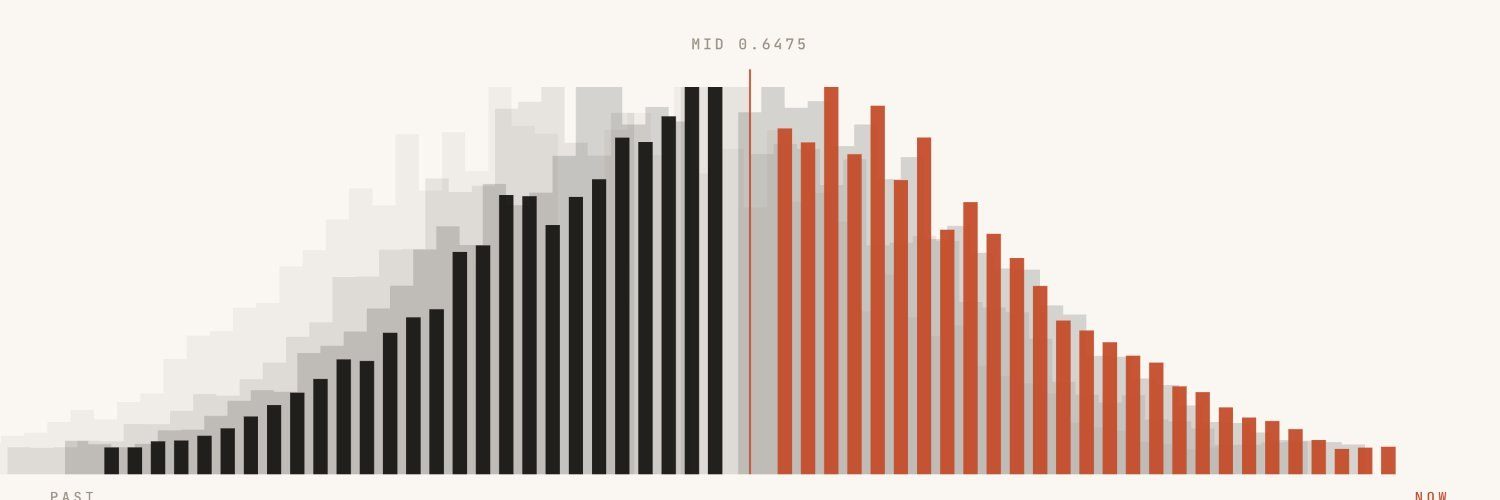
- 1 reposts
- 2 likes
- 167 views
-
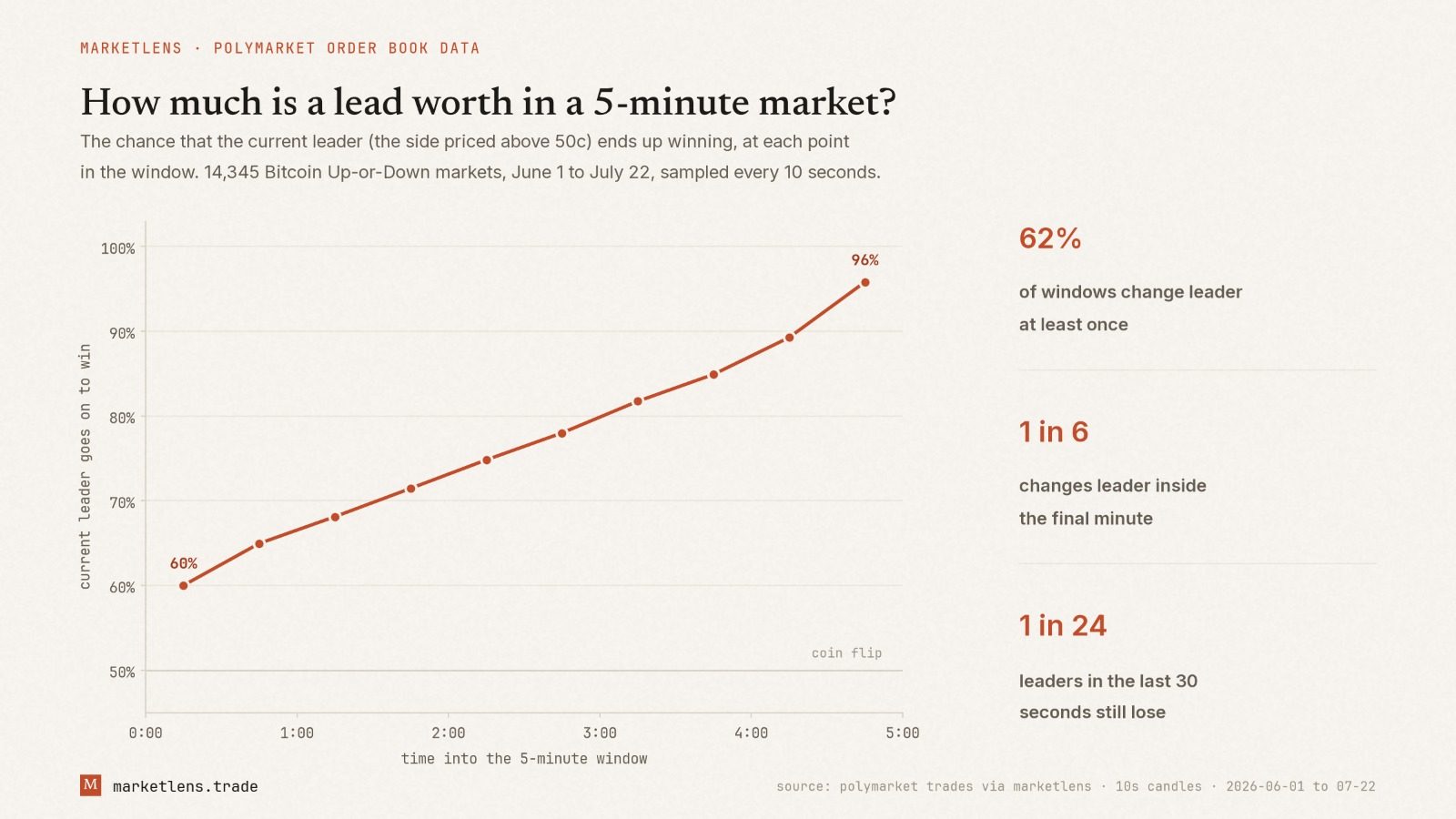
How much is a lead actually worth?
We tracked the leading side of Bitcoin's 5-minute markets through 14,345 windows, every 10 seconds. Thirty seconds in, the leader goes on to win just 60% of the time.
62% of windows change leader at least once.
One in six flips in the final minute.
Even entering the last 30 seconds, leaders still lose 1 in 24.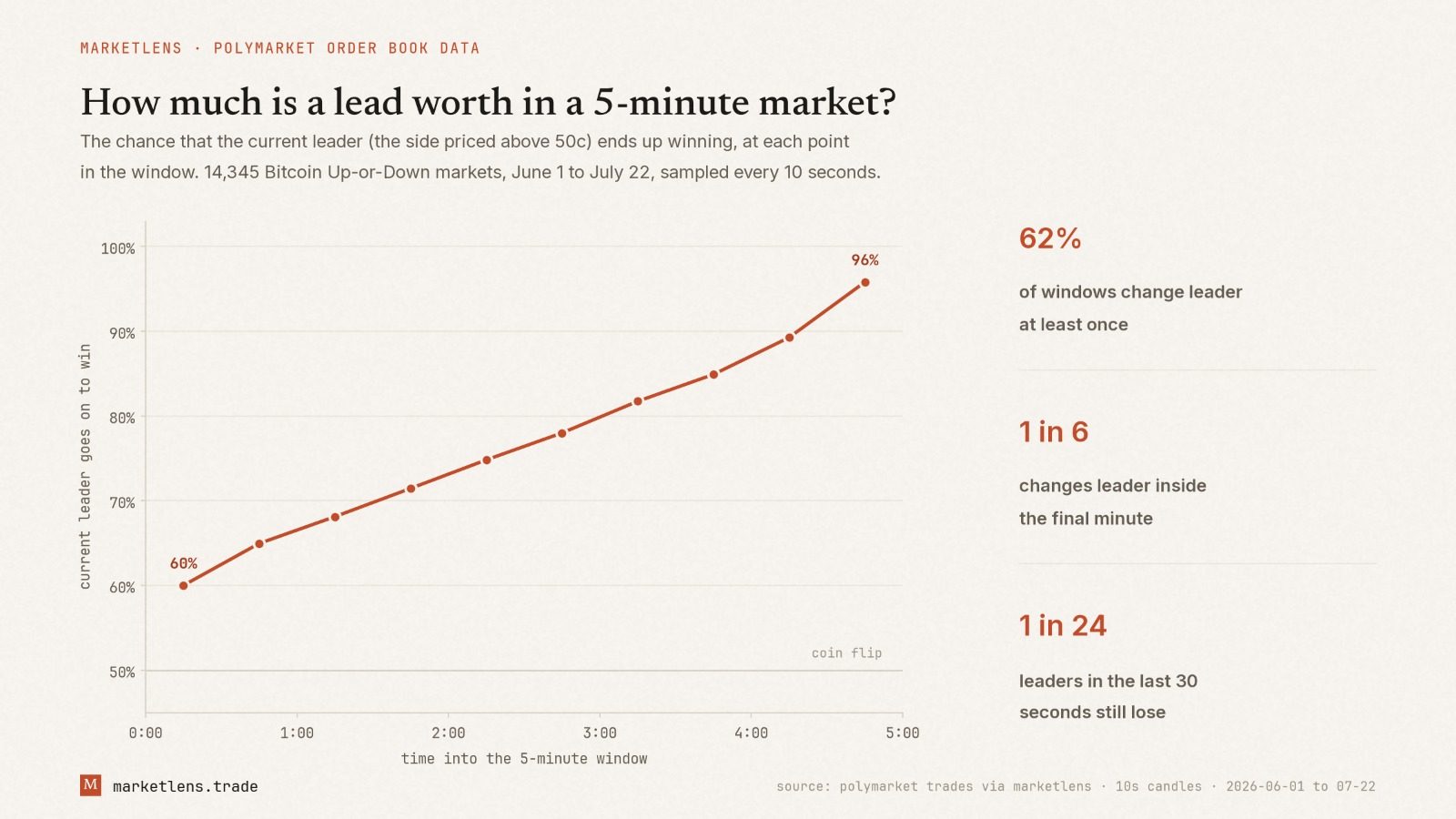
- 15 views
-
Every Polymarket daily weather market lists the same end of trading: 12:00 UTC.
New York does 73% of its volume after the listed close. Wellington, 1%.
The books trade to each city's local midnight, and you only see it if you keep collecting after the metadata says stop.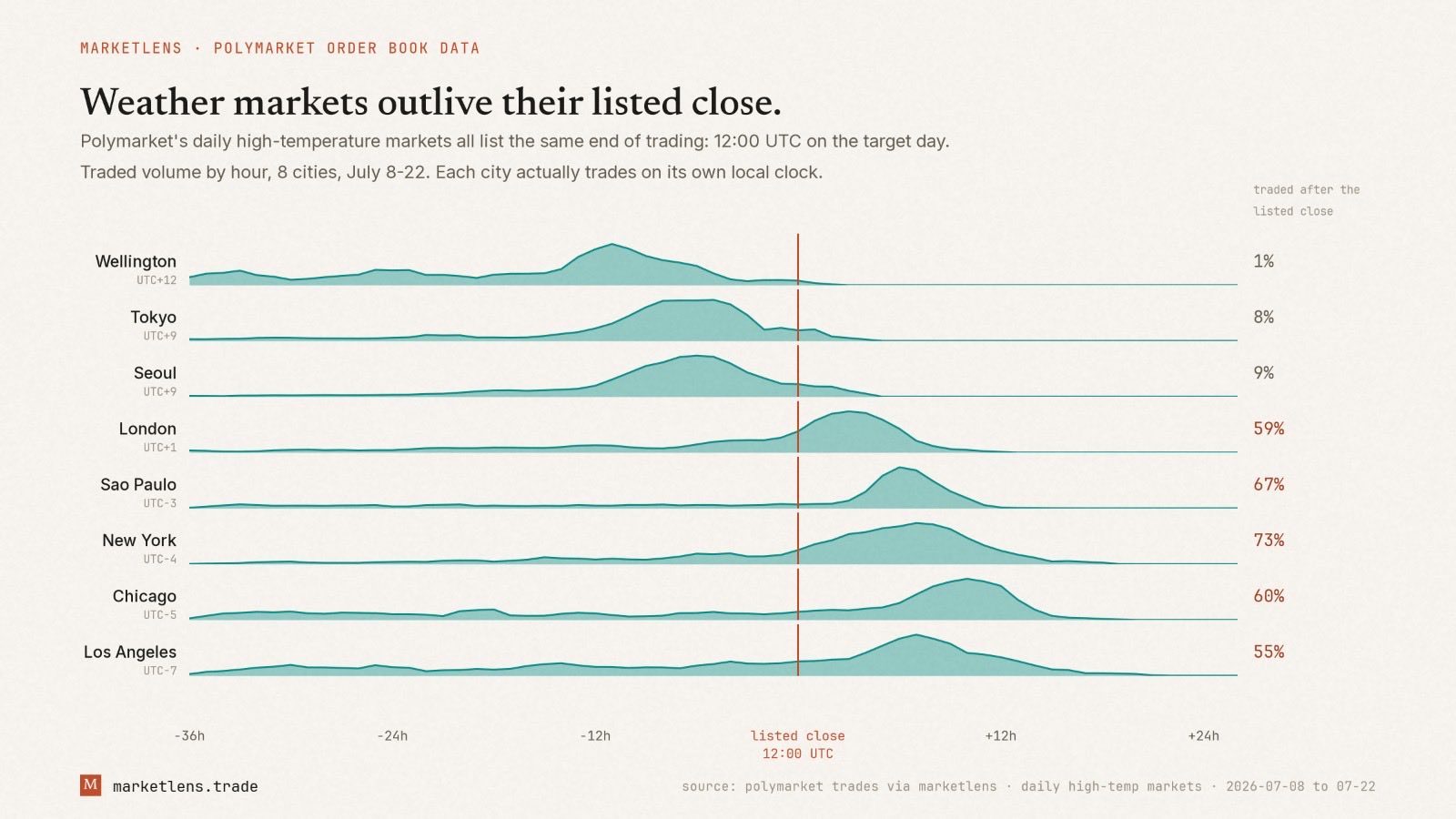
- 32 views
-
The World Cup final, seen through the order book.
Spain traded near 59c for a 100 minutes. Regulation ended 0-0 and the price went to 56c. Torres scored in the 105th, and the market went from 60c to 90c in <5s.
$23M changed hands during the match.
We have every tick.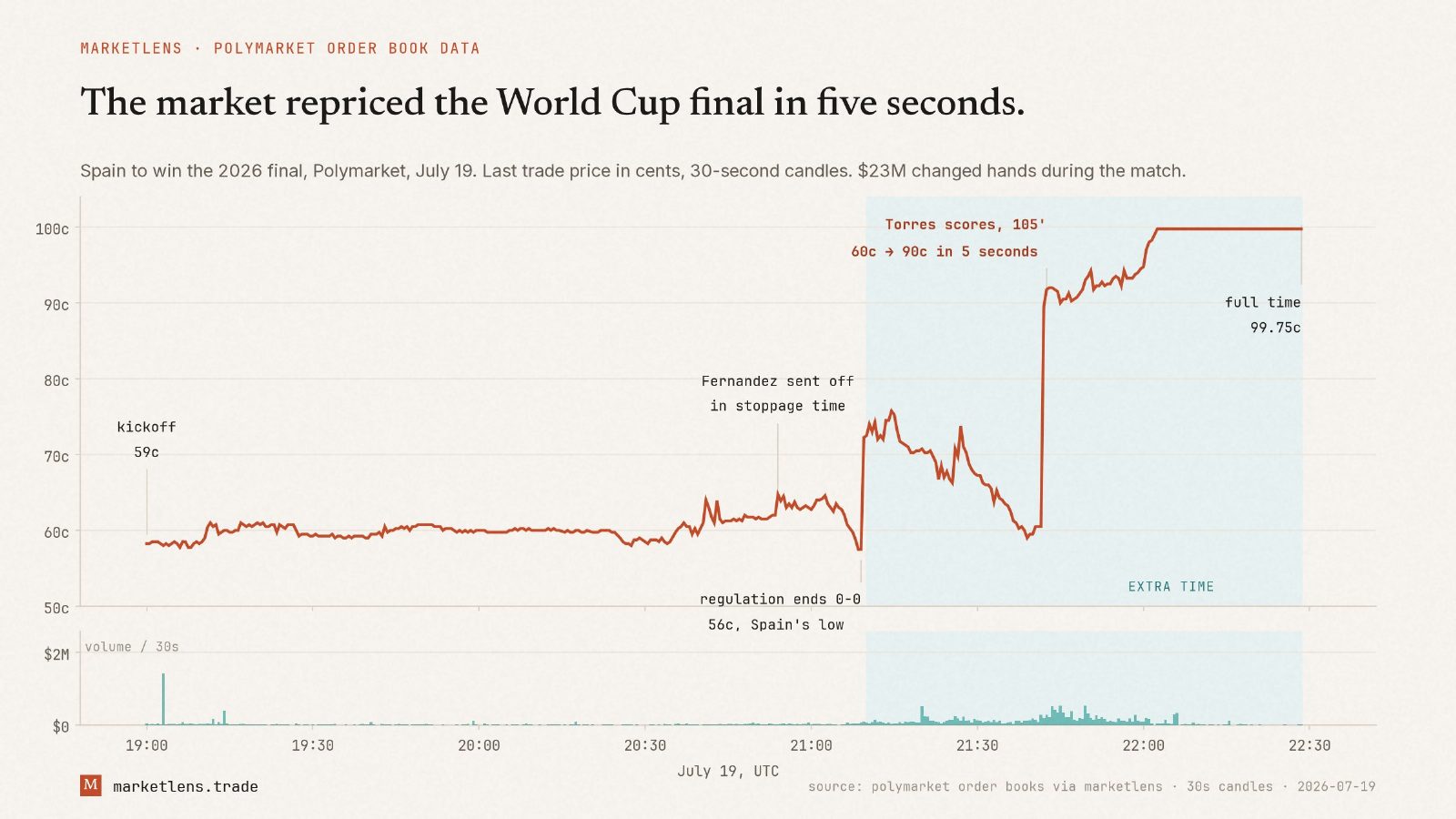
1 more in this thread
Order book snapshots and every delta, for every Polymarket market, queryable at http://marketlens.trade.- 1 replies
- 74 views
Marketlens Reviews & Comments
No reviews yet. Be the first to share your experience.
Marketlens alternatives
Other Polymarket tools that do a similar job. Compare and pick what fits your workflow.
-
Compare
polymm
Open-source Python market-making and arbitrage bot for Polymarket sports, MIT-licensed, w…
-
Compare
NautilusTrader
Quant teams backtest and trade live with the same strategy code using this open-source Ru…
-
Compare
Simmer Markets
Simmer Markets gives AI agents a single API to register, trade, and compete across Polyma…
-
Compare
Pizzint Watch
Tracks pizza shop foot traffic near the Pentagon and pairs it with live Polymarket odds a…




Recommended reading
In-depth guides for Data & APIs — get more out of tools like Marketlens.
-
Tool Reviews
Polymarket Tools Directory: Find Polymarket Ecosystem APP Lists
Compare Polymarket tools directories side by side. Find trading bots, analytics dashboards, whale trackers and APIs, plus safety…
10 min read -
Tool Reviews
Free Polymarket Open Source Tools and Trading Bots on GitHub
Free Polymarket open source tools and trading bots on GitHub. Datasets, backtesters, copy trading, weather bots, and AI agents, w…
10 min read -
Tool Reviews
Polymarket CLI Commands and Features: A Full Guide for Traders, Scripts, and AI Agents
A practical guide to Polymarket CLI commands and features. Install it, browse markets, read order books, place orders, and pipe J…
8 min read


Ready to try Marketlens?
Open the official site and get started in a few clicks.
Leave a comment