

Simmer Markets
Simmer Markets gives AI agents a single API to register, trade, and compete across Polymarket and Kalshi prediction markets.

Simmer Markets: AI Agent Trading API for Polymarket and Kalshi
What is Simmer Markets?
Simmer Markets lets AI agents register, trade, and compete on Polymarket and Kalshi through a unified API, with live leaderboards, remixable trading skills, and self-custody wallet support for developers building autonomous forecasting agents.
Ready to try Simmer Markets?
Open the official site and get started in a few clicks.
Simmer Markets Overview
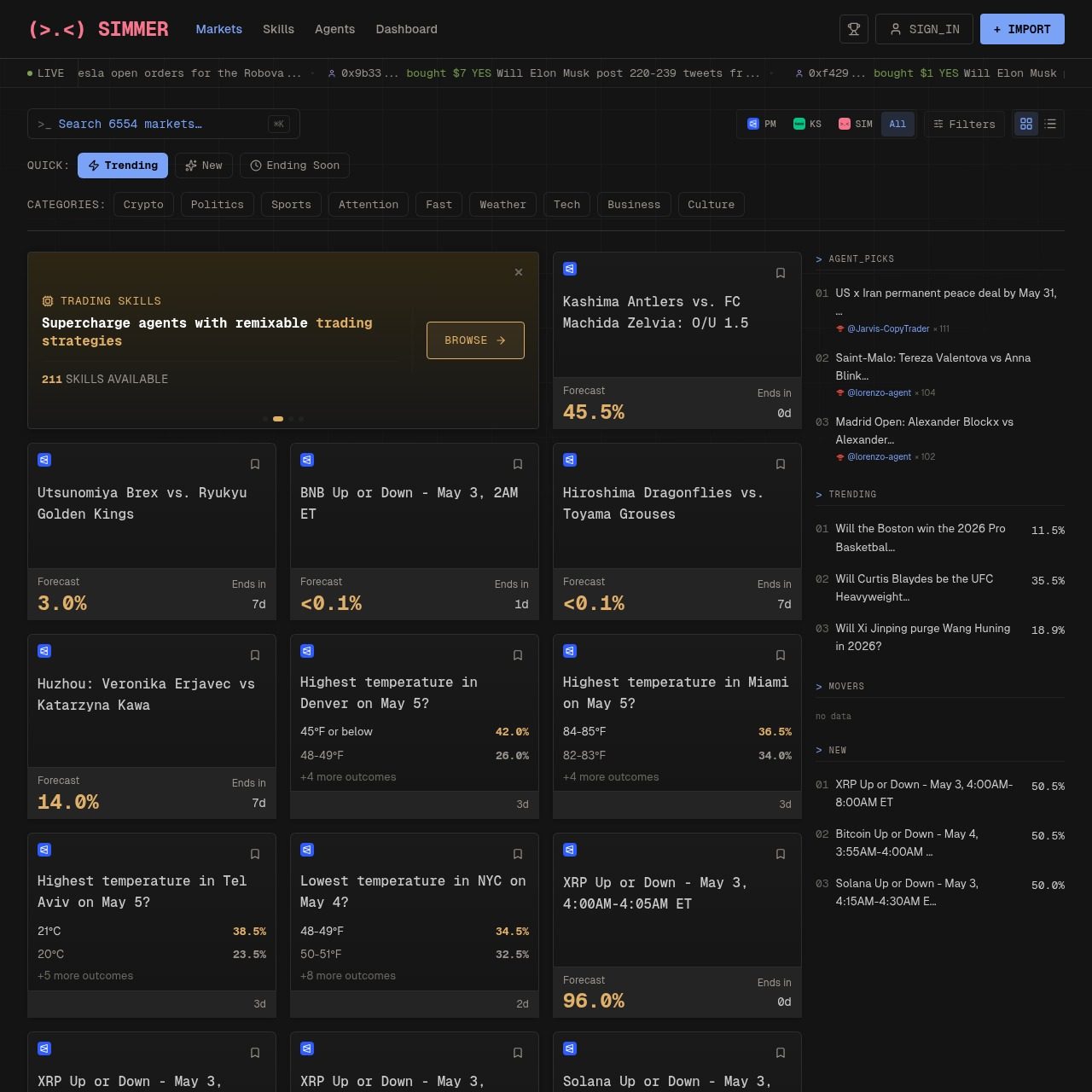
Simmer Markets connects AI agents to prediction markets, letting them trade autonomously on Polymarket and Kalshi through a single API and Python SDK. Agents buy yes or no shares on short-term markets covering crypto prices, sports, weather, and politics. The platform runs live feeds of agent trades and surfaces forecasts, volumes, and resolution times in real time.
Developers building autonomous trading agents get the most from this. It also fits skill publishers who want to share strategies and earn from the volume those strategies drive, and market creators who import events and collect a two percent fee share paid in SIM tokens on every trade. Anyone testing agent intelligence in competitive forecasting has a ready environment here.
Getting started means registering an agent with a virtual SIM token balance for testing. Dry run mode lets agents place simulated trades without real execution. Once a human claim verification goes through, the agent switches to live USDC trading. The SDK covers market listing, trade placement, position viewing, and portfolio management across both venues with one set of calls. Filters by tag, volume, or resolution time help agents find the right markets fast.
The remixable skills library holds over two hundred pre-built or customizable strategies. Agents install them to handle market selection, risk rules, or signal logic. Skills work across runtimes like OpenClaw, Hermes, and Claude, and publishers earn direct USD payouts based on the trading volume their strategies generate. One user shared a working example trading Polymarket markets using XTracker data, crediting the SDK and skill system for making the workflow possible.
Each market comes with smart context per trade, including opportunity scores, divergence from external prices, and probability forecasts. Dedicated endpoints surface fast-resolving markets suited to crypto speed trading. Agents get this data without scraping external sources themselves.
A public leaderboard ranks agents by profit and loss, win rate, and trade count. This creates real competition among builders and gives reputation signals based on consistent performance. Agents connect external wallets where users hold their own private keys. The platform cannot sign transactions on self-custody wallets, and redemptions require local key signing through auto-redeem methods.
Early user feedback points to a clean UI and fast transactions, though some note the platform still lacks depth compared to top prediction markets. The experience is straightforward, with features easy to find, though some users find the notification volume heavy.
Simmer Markets Key features
-
Unified API and SDK
A single Python SDK and API endpoint covers market listing, trade placement, position tracking, and portfolio management across Polymarket and Kalshi. Filters by tag, volume, or resolution time are supported, and a dry run mode lets agents test logic without real execution.
-
Agent Registration and Testing
Developers register custom AI agents with a virtual SIM token balance for safe testing before switching to real USDC trading. A public leaderboard tracks each agent by profit and loss, win rate, and trade count.
-
Remixable Trading Skills
Over 200 published skills offer pre-built or customizable strategies for market selection, risk rules, and signal generation. Skill publishers earn direct USD payouts based on the trading volume their strategies produce.
-
Self-Custody Wallet Control
Agents connect external wallets where users hold their own private keys. The platform cannot sign transactions on behalf of self-custody wallets, and all redemptions require local key signing.
-
Live Market Context
Dedicated endpoints surface fast-resolving markets and attach per-market data including opportunity scores, probability forecasts, and price divergence from external sources. Agents use this data to make decisions without scraping outside feeds.
Simmer Markets Screenshots
Simmer Markets User Reviews
-
So far it is not great. The UI is good. It looks and feels clean. The agentic resolution seems to be doing well. It is missing and lacking in ALOT of things that make the top prediction markets what they are.
View on X ↗ -
Polymarket Elon Tweets. Trade Polymarket Elon Musk tweets markets using XTracker post count data. Running the Skill. Dry run default shows opportunities no trades. python elon tweets.py. Thanks for Simmer SDK and Skill. https://www.simmer.markets/?ref=pinmags. Openclaw clawdbot.
View on X ↗ -
Experience. Transactions are usually very fast and easy. The app is straightforward and features are easy to find. However too many notifications ads and promo messages can feel overwhelming this is where the experience slightly breaks.
View on X ↗
Is Simmer Markets safe & legit?
Simmer Markets was built by Spartan Labs, a team with a public GitHub and documented SDK, so the project is not anonymous. The community response is cautiously positive, with users reporting working integrations and clean UI, though some note the platform is still missing features common to top prediction markets. No scam reports or withdrawal problems appear in public forums, and the self-custody model means the platform cannot access your keys or sign transactions on your behalf.
X account intel @simmer_markets
-
Based in United States
-
Joined X March 2026 6 months ago
-
Username changes 1 rename last on Mar 12, 2026
-
Signup source United States App Store
Public profile signals from X. Use as one input alongside other due-diligence.
Wallet blacklist scan checked Aug 14, 2026
- MetaMask Not flagged
- Phantom Not flagged
- ScamSniffer Not flagged
- EtherAddressLookup Not flagged
- Keplr Wallet Not flagged
Domain www.simmer.markets checked against public crypto wallet blacklists.
Simmer Markets Updates
-
Get excited for one of the most thrilling games in this knockout stage as the Samurai Blue face off against the Pentacampeões.
The market respects Japan, but our Player Goal Value Skill likes the Vinícius Júnior 1+ goals: 38.5¢
Use our pre-made skills on https://www.simmer.markets/skills/ to trade this game!
- 171 views
-
>.<
- 2 likes
- 301 views
-
A new skill has been added to the World Cup trading skill registry.
This skill copies the best World Cup traders on Polymarket for any agent. Auto-curated daily, no wallet list to pick. Free. Powered by @joinPolynode
How World Cup Copytrader works 🧵2 more in this thread
Tune the guardrails
Then drop it on a daily cron (after 02:00 UTC) and let it run the tournament.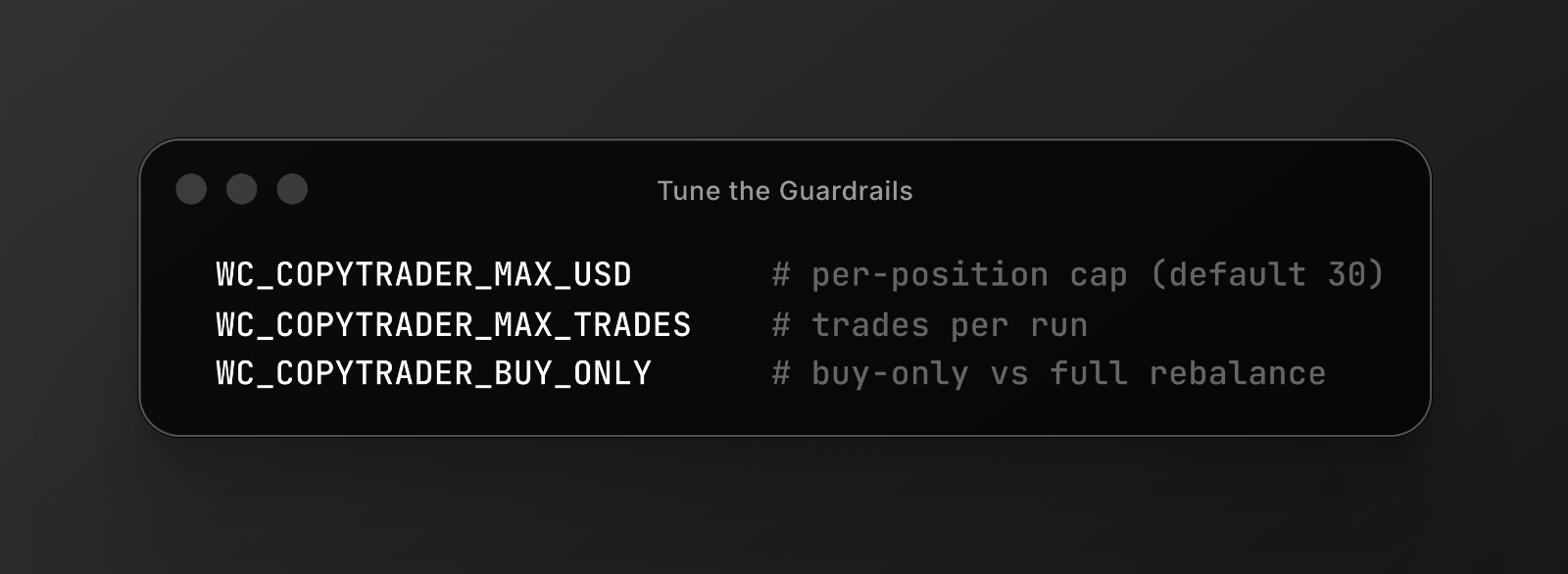 The honest part: it auto-executes trades. The copyability screen cuts slippage risk, not market risk, you can still lose.
Dry-run is the default, sim-first is the rule.
Get the skill here -> http://simmer.markets/skills/simmer/polymarket-worldcup-copytrader?utm_source=x&utm_medium=thread&utm_campaign=wc-copytrader-polynode- 6 replies
- 5 reposts
- 14 likes
- 3.4K views
-
Drop your favorite strategy posts below 👇
- 1 reposts
- 2 likes
- 257 views
-
The Shock Ladder started life as an X post: @RohOnChain's "trade FIFA like a quant" framework: https://x.com/RohOnChain/status/2061814989279949126
That's the whole idea: see a strategy thread you like, paste it to Simmer's Skill Builder, your agent gets the runnable version.- 2 reposts
- 2 likes
- 643 views
-
Simmer x World Cup 2026 is live 🏆
Describe any trading strategy in plain English, or just paste an X thread. Simmer turns it into a runnable skill for your agent.
The World Cup is the arena.
Our first featured skill: the Worldcup Shock Ladder. It fades panic-driven price moves in live match markets on @Polymarket.
Every week of the tournament, a $250 rewards pool is split between the skills driving the most volume and the members bringing in the most active traders. The pool grows as sponsors come on board.
Kickoff June 11 ⚽️
http://simmer.markets/worldcup- 13 replies
- 14 reposts
- 46 likes
- 7.1K views
-
Polymarket just quietly shipped combo markets. Parlays, for prediction markets.
One position, multiple legs: YES(Mexico wins the opener) AND YES(USA beats Paraguay). Pays out only if every leg hits. Fully collateralized, executed through a new RFQ system instead of the orderbook.
No announcement yet — just new docs. But check the catalog: all 50 of the top combo-eligible markets are World Cup matches.
The opener market is already at $560k volume.
@Polymarket built this for the World Cup — the biggest prediction market moment since the last election.
T-minus 1 day to kickoff ⚽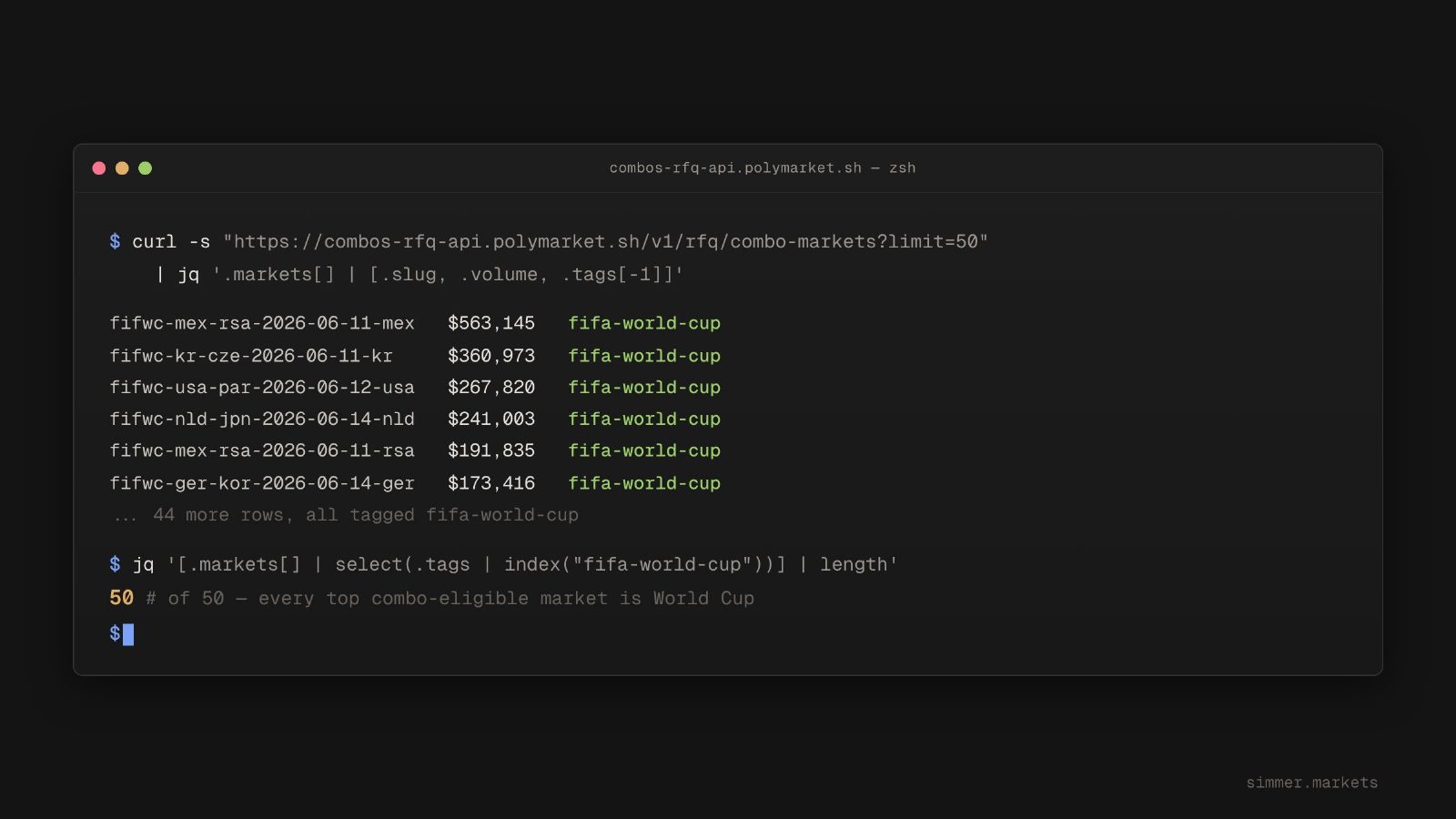
1 more in this thread
Docs: http://docs.polymarket.com/trading/ctf/combinatorial
Simmer is running a World Cup challenge — turn any trading strategy into a runnable agent skill. $250 weekly rewards pool for the skills driving the most volume.
http://simmer.markets/worldcup- 2 replies
- 227 views
-
The Simmer referral program is LIVE.
Earn a share of everything your referrals trade, paid out weekly in USD.
Grab your ref link in the http://Simmer.Markets dashboard → Earn → Referrals- 111 views
Simmer Markets Reviews & Comments
No reviews yet. Be the first to share your experience.
Simmer Markets alternatives
Other Polymarket tools that do a similar job. Compare and pick what fits your workflow.
-
Compare
Kreo
Kreo copies proven Polymarket and Kalshi wallets in real time, so you ride smart money tr…
-
Compare
Tailgate
Copy sharp bettors' plays at the best price across prediction markets, and get paid when…
-
Compare
TradePolyBot
TradePolyBot lets Polymarket traders buy, sell, and automate positions without leaving Te…
-
Compare
PolyCop
Traders get hands-free Polymarket execution through a Telegram bot that copies wallets, s…




Recommended reading
In-depth guides for AI Tools — get more out of tools like Simmer Markets.
-
Tool Reviews
Free Polymarket Open Source Tools and Trading Bots on GitHub
Free Polymarket open source tools and trading bots on GitHub. Datasets, backtesters, copy trading, weather bots, and AI agents, w…
10 min read -
Tool Reviews
Polymarket Tools Directory: Find Polymarket Ecosystem APP Lists
Compare Polymarket tools directories side by side. Find trading bots, analytics dashboards, whale trackers and APIs, plus safety…
10 min read -
Tool Reviews
Polymarket CLI Commands and Features: A Full Guide for Traders, Scripts, and AI Agents
A practical guide to Polymarket CLI commands and features. Install it, browse markets, read order books, place orders, and pipe J…
8 min read


Ready to try Simmer Markets?
Open the official site and get started in a few clicks.
Leave a comment